
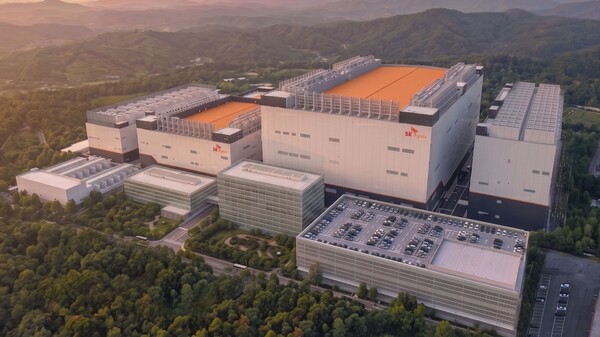
SK hynix said on Aug. 7 it has decided to build two new fabs in Yongin, Gyeonggi Province, and Cheongju, North Chungcheong Province. After a board resolution that day, it decided to invest about 54 trillion won, including 35.2 trillion won in Yongin "Y2" and 19.1 trillion won in Cheongju "M17". A fab is a production plant that makes semiconductors. Yongin will be developed as a DRAM production base and Cheongju as a NAND production base. The spread of AI services is driving rising memory demand into competition to expand production facilities.
The decision is a step-by-step implementation of a mid- to long-term investment strategy announced in June. The company set plans to invest 600 trillion won in the Yongin semiconductor cluster and 100 trillion won to expand the Cheongju production base. It is currently building the first Yongin fab, "Y1", with construction under way targeting the opening of the first cleanroom in February next year. It moved forward the cluster completion target from 2045 by 12 years to 2033. Market researcher Omdia forecasts both DRAM and NAND demand will maintain average annual growth of 19 percent in both markets from last year to 2030.
SK hynix said, "In the AI era, technological competitiveness alone is not enough, and the ability to supply the required volume when customers need it is competitiveness." It added, "We decided on this investment after a close review of demand."
Yongin Y2 will be the second of four fabs to be built sequentially in the cluster and will be developed as a DRAM production base with a total floor area of 341,000 pyeong. Construction will start in July next year and the first cleanroom will open in June 2029. It will produce next-generation DRAM, including HBM, a high-performance memory that stacks multiple layers of memory to increase data processing speed. The investment will be carried out in stages through October 2031. The cluster's phase-one power and water infrastructure needed to run Y2 has entered the final stage, with 99 percent progress.
Demand for NAND is rising rapidly, centred on enterprise SSDs used as corporate storage devices, as AI services expand in earnest. Demand for KV cache, which stores and reuses previous computed values during AI inference, has added to that. The reason it chose Cheongju as a new NAND base is that it can build the fab the fastest. The Cheongju campus has M11, M12 and M15, which produce NAND, enabling production linked with existing fabs, and much of the land and power and water are also in place. M17 will have a total floor area of 206,000 pyeong, with construction to start in February next year.
The M17 investment period will run through April 2031, and it will be executed in stages in line with the project schedule. SK hynix plans to secure production infrastructure first based on mid- to long-term demand, while expanding actual production capacity to match when customers need it. It also plans to proceed sequentially with cleanroom expansion and equipment installation in line with demand trends.
An SK hynix official said, "This investment is a decision to avoid missing the opportunity in line with the pace of market growth." The official added, "Through securing a proactive production base, we will establish ourselves as a key partner in AI infrastructure that contributes to stability in the global AI semiconductor supply chain."
 Daegeon Seok
d2dg@d-today.co.kr
Daegeon Seok
d2dg@d-today.co.kr