
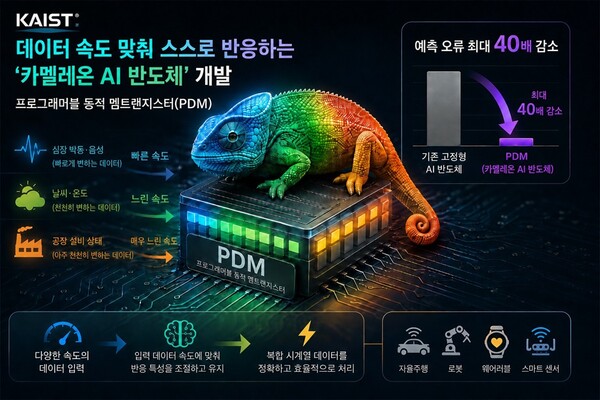
A research team at the Korea Advanced Institute of Science and Technology (KAIST) has developed an AI semiconductor device that adjusts its response characteristics in line with the speed of data changes.
KAIST said on Thursday that a team led by Hyun Cheol Choi (최신현), a chaired professor in the School of Electrical Engineering and the Graduate School of Semiconductor Engineering, developed a "programmable dynamic memtransistor (PDM)" and an array integrating it.
A memtransistor is a next-generation semiconductor device that combines memory, which stores information, with a transistor function that performs computation. It can remember prior information while computing data, allowing it to adjust response speed depending on input data.
Existing AI chips have fixed response speed to input signals and fixed retention time for maintaining a state, limiting efficient processing of data that changes at different speeds.
The team combined, within a single transistor, a charge storage layer that stores electrical information and an electron trapping layer that stores electrons to control the semiconductor's response speed. When data are input, the PDM processes information in the charge storage layer, while the electron trapping layer controls how quickly the semiconductor returns to its original state. This allows selection of response characteristics suited to the data's rate of change.
KAIST said experiments showed the time for the semiconductor to return to its original state after responding to an input signal could be adjusted over about a fivefold range. Frequency characteristics for processing rapidly repeating signals were also adjusted by more than 10-fold. In time-series data prediction tests that included both fast and slow information, prediction errors were cut by up to 40-fold compared with existing fixed-type semiconductors.
The team also built an array connecting multiple PDMs. Experiments confirmed it operated with less energy while maintaining accuracy similar to existing software-based AI systems.
The device also has non-volatility, meaning the set response characteristics are maintained without power supply. The team said it is compatible with CMOS processes used in commercial semiconductor manufacturing, raising the possibility of mass production and commercialisation.
Hyun Cheol Choi said, "We implemented an AI semiconductor that responds in the most suitable way according to the speed of data changes," and added, "We expect it to become a key technology for improving performance and reducing power consumption in various AI devices such as self-driving cars, robots and wearable devices."
The research included Dae-won Kim (김대원), a doctoral candidate at KAIST's Graduate School of Semiconductor Engineering, as first author. Young-taek Oh (오영택), a researcher at Samsung Electronics' Semiconductor Research Center, and Jae-deok Lee (이재덕), a fellow, also participated as co-authors, and Choi served as corresponding author. The results were published in the international journal Nature Communications in July.
 Jin-ho Lee
jhlee26@d-today.co.kr
Jin-ho Lee
jhlee26@d-today.co.kr