
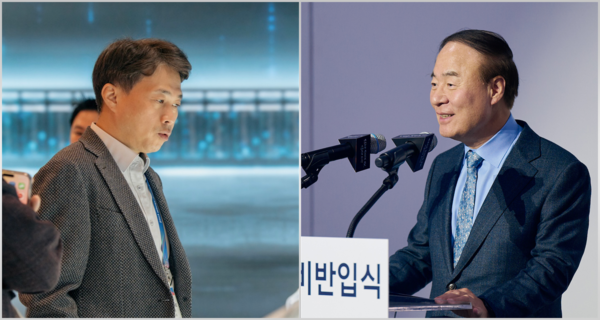
Samsung Electronics and SK Hynix are shifting memory sales to multi-year long-term supply agreements (LTAs) but are taking different approaches. Samsung is focusing on expanding coverage by locking in at least 60 to 70 percent of production capacity under contracts that fix price and volume. SK Hynix, considering that it cannot fully meet demand, has chosen to keep some volumes outside contracts to maintain exposure. With contract terms undisclosed, the success of the two choices is expected to be seen in earnings and the scale of shareholder returns.
On Aug. 11, the industry said Samsung Electronics and SK Hynix are moving from a memory sales model that aligned volume and price on a quarterly and annual basis to multi-year LTAs. The contract format is moving in the same direction, but the two companies' choices differ in scope and pace.
Samsung Electronics is putting more weight on widening contract coverage. Hanwha Investment & Securities expects Samsung Electronics' LTAs under negotiation to expand to at least 60 to 70 percent of total production capacity (CAPA).
The binding nature of the contracts has also changed from the past. The basic LTA term is reported to be set at 5 years. The basic framework is to receive at once a certain portion of the contract size for the full period in the form of a deposit. If a customer terminates the contract midway, it typically must pay the full penalty equivalent to 5 years.
SK Hynix, by contrast, has chosen an approach that builds up the number of contracts while leaving the share itself open. SK Hynix said it has concluded LTA talks with about 10 companies, including key customers, and is continuing additional discussions with major customers. It said the multi-year contracts would strengthen medium- to long-term business stability. It did not disclose counterparties, contract periods or volume terms.
SK Hynix's LTA terms are expected to differ by customer. They appear to be set with key customer Nvidia as a reference while applying different settings for other customers. With demand fulfillment currently below 70 percent, SK Securities said the LTA share is a matter of choice. As deeper supply shortages leave room to capture price increases on volumes outside contracts, the focus appears to be on managing a combination of price, volume and a safety net through individual contracts while also managing exposure to the non-LTA market.
Observers see differences in the challenges each company faces behind the diverging approaches. The industry expected Samsung Electronics to resolve recurring duplicate booking problems through LTAs. Memory capacity expansion has been built on a practice in which customers place overlapping orders with multiple suppliers, which has led to overexpansion in boom periods and sharp price falls. A view has been raised that higher contract coverage would allow expansion plans based on more accurate demand forecasts.
SK Hynix views the essence of LTAs as a form of 'mutual hostage-taking' with customers. It believes this will structurally raise profit visibility, durability and the lower bound of earnings compared with the past. With partnerships secured with major customers on the back of high-bandwidth memory (HBM) competitiveness, SK Securities said there is no reason for its contract share to fall to the lower ranks of the industry.
The impact is already reflected in results. Samsung Electronics' second-quarter revenue rose 130 percent year on year to 171.5 trillion won, and operating profit jumped 1,813.83 percent to 89.5 trillion won. Revenue at its DS division was 127.5 trillion won and operating profit was 89.2 trillion won. SK Hynix posted revenue of 79.3 trillion won and operating profit of 60.5 trillion won, with an operating margin of 76 percent. Both companies set record highs for a second straight quarter.
Valuation yardsticks are also shifting. SK Securities cited high fixed costs and inventory burdens, oversupply and short profit duration as traditional discount factors for memory makers. As indicators for the AI era, it presented a rising LTA share, customer-by-customer production capacity reservations, and prepayment and deposit structures. The logic is that lower earnings volatility would enable valuation based on the price-to-earnings ratio (PER). Hanwha Investment & Securities kept its target price for Samsung Electronics at 580,000 won, and SK Securities kept its target price for SK Hynix at 4,000,000 won.
SECOND INFORMATION ASYMMETRY CREATED BY UNDISCLOSED CONTRACTS
All LTA terms are undisclosed. Contract periods, deposit sizes and whether price floors and ceilings are set are shared only between contract parties. SK Securities pointed out that LTAs with some customers cannot explain the nature of all LTAs. With no way for outsiders to verify an individual company's contract terms, there is room for fragmentary information to be interpreted as differences in competitiveness.
SK Hynix in fact shared relatively less detailed information on LTAs than competitors during its second-quarter earnings conference call. At a subsequent non-deal roadshow (NDR), market questions focused on LTAs and shareholder returns. SK Securities said it "warns against differences in policies and situations between companies being misunderstood as differences in fundamental fundamentals or will".
Information asymmetry has been developing since before LTAs. Up to HBM3E, specifications were disclosed under standards set by the Joint Electron Device Engineering Council (JEDEC), but from HBM4, core information shifted to nondisclosure as customer-specific custom logic dies were used. In custom HBM, only chips that meet a specific customer's requirements are recognized as good products and cannot be resold to other customers. With inventory flexibility gone, even small production disruptions can spread into concerns about supply disruptions. Controversy over SK Hynix's timing for mass production of HBM4 also emerged against this backdrop.
The industry said various market speculations about LTA terms are not unrelated to this structure. In a structure where contract terms cannot be laid open, what remains are the numbers that are executed. As channels that gauged supply and demand through standard specifications and spot prices have narrowed, and contract terms have also been closed, the market has been left with no means of confirmation other than company explanations. Ultimately, verification is narrowed to earnings and shareholder returns. An industry official said, "LTAs can be seen as profit stability, and shareholder returns as cash flow credibility," adding, "The cycle's amplitude has shrunk with LTAs, but given that large-scale investment continues, returns are another issue."
 Dae-geon Seok
d2dg@d-today.co.kr
Dae-geon Seok
d2dg@d-today.co.kr