
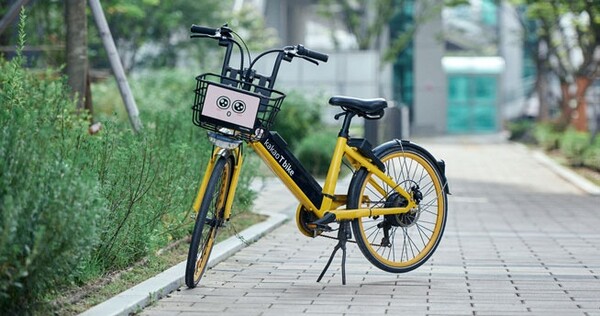
A merger and acquisition push that had drawn attention over whether it would create an overwhelming No. 1 operator in South Korea’s shared electric bicycle market has ultimately collapsed.
Socar has recently scrapped the sale of its electric bicycle business unit, Elecle, which it had pursued since the second half of last year. The company that went as far as final negotiations was Kakao Mobility, which operates T Bike. Had the deal gone through, a monopolistic micromobility operator could have emerged based on cumulative subscribers and travel distance. But the final sale fell through as multiple factors, including technology, combined.
ㆍ[Exclusive] Socar-Kakao Mobility shared e-bike business merger collapses
South Korea’s mobility platforms are expanding beyond transport services into closely tied daily-life businesses such as finance and maintenance.
T Map Mobility said it partnered with Hankook Tire’s car service chain T’Station to offer tire discount benefits. Socar said it signed a strategic memorandum of understanding with AXA General Insurance for cooperation on developing data-based insurance products and new business collaboration.
ㆍT Map expands car lifestyle platform... now sells tires and insurance ㆍSocar-AXA General Insurance to cooperate on in-app insurance sales, data-tailored products
Tesla’s development process for its flagship Model 3 is drawing attention again. Elon Musk has personally acknowledged that excessive automation during mass production instead hurt production efficiency, prompting what appears to be a reappraisal of manufacturing strategy.
Interest is also growing in how trial and error during the Model 3 production process later influenced changes in Tesla’s factory operations and production philosophy. Tesla has also recently focused on strengthening its software competitiveness, including adding voice AI and a parking memory function to FSD.
ㆍLessons from Tesla Model 3... Elon Musk acknowledges excessive automation ㆍTesla adds Grok voice commands, parking memory to FSD... Elon Musk: "to be introduced within 3 months"
Tesla is accelerating expansion in the European market despite controversy surrounding its autonomous driving technology. As class-action lawsuits over FSD and scrutiny from regulators continue, some countries are widening approval scopes, expanding the basis for commercialisation.
At the same time, an assessment is emerging that Tesla faces the dual tasks of advancing autonomous driving technology and securing market trust, as complaints from owners, regulatory risks and delays in robotaxi expansion are raised simultaneously.
ㆍ"Keep your FSD promise"... participants in class action over Tesla HW3 vehicles near 7,000 ㆍ"Remove the speeding feature"... Sweden moves to block Tesla FSD EU approval ㆍThere were no accidents, but no expansion either... the reality of Tesla robotaxis
Against that backdrop, China’s autonomous driving market is growing rapidly and is emerging as the centre of global competition. BYD sharply raised usage of its autonomous driving functions by promoting an accident compensation policy, while Baidu is increasing its presence by standing out in robotaxi competitiveness assessments.
ㆍBYD’s full coverage for urban driving proves effective... 'God’s Eye' usage rate surges to 93 percent ㆍChina’s Baidu beats Waymo in first global robotaxi ranking... Tesla fifth
Rivian is also accelerating the popularisation of autonomous driving technology. It has signalled it will launch a supervised driving assistance function similar to Tesla’s FSD within this year, and it has also offered a forecast that autonomous driving functions will eventually become a standard safety feature like airbags.
ㆍRivian CEO: "To launch supervised driving assistance similar to Tesla FSD within the year" ㆍRivian CEO: "Autonomous driving will also become airbags"... the $8,000 era will end
An analysis has found that while robotaxis could reshape the taxi and ride-hailing market, it will not be easy for them to replace the U.S. market for ordinary passenger cars. Even if autonomous driving technology removes the driver, it may be difficult to become a more attractive option than private cars if it cannot solve issues such as costs, convenience and inefficiency from empty vehicle operations.
ㆍWhy robotaxis will struggle to replace private cars ... cost, waiting time, empty vehicle operation
Electric vehicles are expanding their presence on the motorsports stage as well, beyond performance limits. Xiaomi’s high-performance EV challenged for a record at the Nurburgring, and Ford’s electric Mustang won a mountain race, beating traditional internal combustion engine powerhouses.
As acceleration and power competition extends to actual race results, EVs appear to be establishing a new standard in the high-performance car market.
ㆍ210 km/h without a driver... Xiaomi YU7 GT sets a new Nurburgring lap time record ㆍBeat all internal combustion cars... 1,400-horsepower Ford electric Mustang wins legendary mountain race
 Jinju Hong
hongjj@d-today.co.kr
Jinju Hong
hongjj@d-today.co.kr