
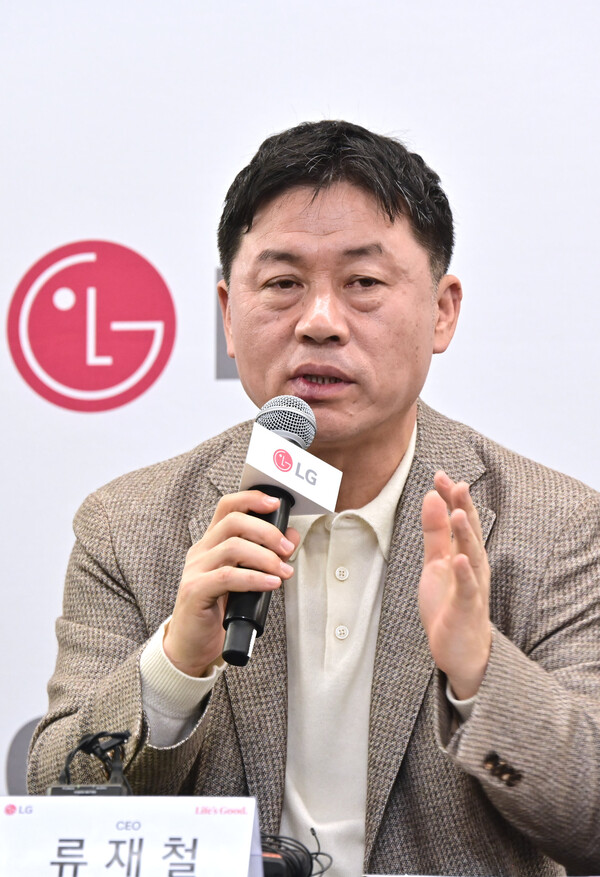
LG Electronics will build a profitability-based growth structure through fundamental competitiveness and a high-performance portfolio shift. LG Electronics Chief Executive Officer Ryu Jae-cheol held a press briefing in Las Vegas on local time Jan. 7 and unveiled its business strategy. In his first press briefing since becoming CEO, he stressed securing fundamental competitiveness and building a profitability-based growth structure through a high-performance portfolio shift.
Ryu said the paradigms of industry and competition surrounding business are changing at a pace never experienced before, and that matching others’ speed cannot guarantee securing the initiative. He said LG Electronics must break from past inertia, take a sober look at the competitive ecosystem it faces and survive only by moving faster and executing strongly.
LG Electronics said it assesses that global market uncertainty and delayed demand recovery are entering a prolonged phase. It also said the U.S. tariff burden that began in earnest in April last year will increase further this year. LG Electronics plans to focus all-out on securing fundamental competitiveness.
The company defined fundamental competitiveness as quality, cost and delivery competitiveness, or R&D and technology leadership that creates a wide gap. It will push innovation in product strength, quality, design and cost structure, while ensuring at least equal speed to the competitive ecosystem across the value chain.
To that end, it created a new innovation promotion unit reporting directly to the CEO to serve as a companywide innovation control tower. The move is intended to have the CEO directly monitor targets and progress by business area.
Planned investment in future growth will rise more than 40 percent from a year earlier.
In R&D and technology, it will select Winning Tech from the perspectives of customer value, business potential and technology competitiveness, and foster it so it can lead trends and contribute to winning competition. It will concentrate R&D resources and capabilities on Winning Tech and on future-preparation tasks for new technologies and new businesses. It will also expand partnerships with leading companies to secure global-level capabilities.
It will speed up a high-performance portfolio shift based on changes to business methods and business-model innovation to respond to external environmental changes such as slowing demand and intensifying competition. Areas for qualitative growth include B2B businesses such as vehicle components and HVAC, non-hardware businesses such as subscriptions and webOS, and online businesses such as D2C, or direct-to-consumer sales.
In particular, its vehicle components business is expected to achieve its highest-ever performance last year. It will continue growth based on a large order backlog while accelerating efforts to lead capabilities beyond SDV, or software-defined vehicles, to AIDV, or AI-defined vehicles. Its HVAC business will secure future growth opportunities by promoting cooling solutions applied to AIDC.
Its smart factory solutions business achieved annual order intake of 500 billion won last year, two years after commercialization. Its subscription business combining products and services posted annual sales of more than 2 trillion won last year. Its webOS platform business is progressing smoothly with double-digit growth or more.
LG Electronics will redefine how it works through AX, or AI transformation, to build speed and execution capability that surpass the competitive ecosystem across the value chain. It set a goal of raising current work productivity by 30 percent within 2 to 3 years.
Resources for future growth this year, combining planned facility investment with intangible investment such as patents, software and IT and strategic investment such as mergers and acquisitions, are expected to rise more than 40 percent from last year.
 Daegeon Seok
d2dg@d-today.co.kr
Daegeon Seok
d2dg@d-today.co.kr