
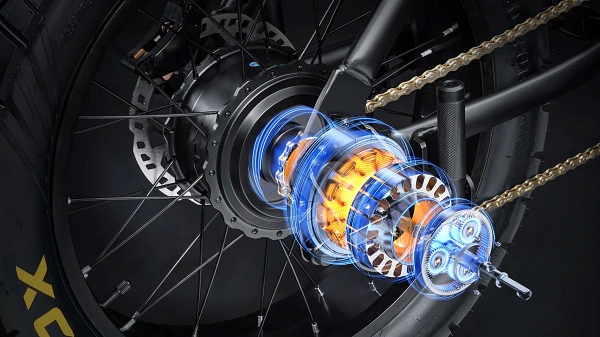
[DigitalToday reporter Jinju Hong] Riders who have spent enough time on electric bicycles quickly realise that strong output alone does not complete the riding experience. Another key factor is sound, or more precisely, the absence of it. A quiet, smooth motor can make an e-bike feel premium, while harsh noise lowers the quality of the overall riding experience no matter how powerful the specifications are.
Bafang, one of the world’s largest e-bike motor manufacturers, has long focused on this “quietness” issue. On Jan. 5 (local time), EV outlet Electric reported on its tour of Bafang’s motor test site and said it became clear that a quiet motor is the result of system-wide design, not a single part.
E-bike motor noise is broadly divided into electromagnetic noise and mechanical noise. Electromagnetic noise comes from fluctuations in magnetic force between the stator and rotor and appears as a high-frequency humming sound. It is often heard like a “crying sound”, especially when load is applied at high assist levels. Mechanical noise stems from gear meshing, bearings and rotational imbalance.
Bafang explains that it does not start with a simple after-the-fact masking approach to reduce noise. It begins by accurately identifying and fundamentally separating these 2 types of noise.
On the electromagnetic side, Bafang applies high-precision magnetic circuit simulation and high-quality silicon steel laminations to minimise magnetic vibration and harmonics. Structurally, it suppresses vibration amplification through a high-rigidity housing and uniform air-gap design. It also uses vibration-damping mounts to prevent subtle motor vibrations from transferring to the frame and being amplified into resonance noise.
Inside the drivetrain, composite-material gears are used with durability and quietness in mind. These gears often have self-lubricating properties, making them much quieter than metal gears even under load.
The rotor undergoes dynamic balancing to suppress eccentric vibration. Bearings are also selected to low-noise specifications tailored to the motor’s speed and load characteristics. These elements may not stand out on a spec sheet, but together they create a smooth and quiet riding feel.
Bafang also operates a dedicated acoustic laboratory with a sound-absorbing environment and precision measurement equipment. Entering the soundproof acoustic test chamber, the extreme quietness is striking to the point that almost no reverberation is felt. In this space, engineers analyse how different operating conditions and variable changes affect noise in specific frequency bands. To eliminate human influence, engineers monitor tests remotely from an adjacent room.
This data-driven approach allows improvements to accumulate over generations, delivering changes that riders feel as “I cannot explain exactly why it is better, but it is clearly different”.
As e-bikes enter a mature phase, what matters is no longer a simple power race. Sophistication, quality and quietness are emerging as factors that differentiate brands and products. A quiet motor not only improves the riding experience, but also affects how pedestrians and regulators view e-bikes. Bafang’s approach shows how much engineering is hidden in areas riders hardly notice.
 Jinju Hong
hongjj@d-today.co.kr
Jinju Hong
hongjj@d-today.co.kr