
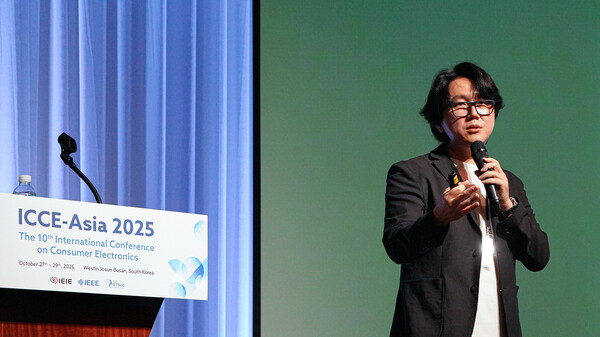
South Korea's Ministry of Science and ICT and the National Research Foundation said on Tuesday they selected Jung Myeongsoo, CEO of Panacea and a chair professor in KAIST's Department of Electrical Engineering, as the January winner of the Korea Science and Technology Award.
The ministry said it elevated the award name to the Korea Science and Technology Award from the previous Science and Technology Person of the Month Award from this year to strengthen the prestige of awards for outstanding scientists.
The ministry said it selected Jung as the winner for his modular AI data center architecture design technology, citing his contribution to cutting AI infrastructure costs and improving efficiency in January, when technology road maps and standards in computing and systems such as next-generation semiconductors and AI are presented, including at CES.
Large-scale AI services such as ChatGPT require large amounts of computing and memory and run on hyperscale systems connecting millions of devices. Existing approaches fixed the ratios of CPUs, GPUs, AI accelerators and memory, making it difficult to adjust them to actual use.
To address this, Jung designed a modular AI data center architecture that allows different devices to be freely combined as needed. He also prepared design guidelines introducing connection methods among multiple devices and the topology between links and devices.
He developed low-power, high-efficiency link technology that separates and manages different system devices into different nodes based on Compute Express Link (CXL), a next-generation interconnect standard. This improved both the scalability of a modular AI data center structure and operational flexibility.
He also proposed integrating accelerator-centric link technologies such as UALink and NVLink and high-bandwidth memory (HBM) semiconductor technology into a modular AI data center structure to build more efficient systems and meet user demand. He has previously disclosed such comprehensive link-based systems and data center structures in the form of a technical white paper.
Jung is the founder of Panacea, a KAIST faculty start-up, and a researcher inducted into the hall of fame of ISCA, described as the most authoritative conference in computer architecture. He is leading innovation in AI infrastructure and semiconductor interconnect technology, including carrying out the ministry's basic research programme twice and winning a CES 2025 Innovation Award for a GPU memory expansion kit.
Jung said he wants to contribute to securing national competitiveness in AI infrastructure through continued research into link technology that can efficiently connect and use devices, in addition to each device's individual performance.
 Jin-ho Lee
jhlee26@d-today.co.kr
Jin-ho Lee
jhlee26@d-today.co.kr