
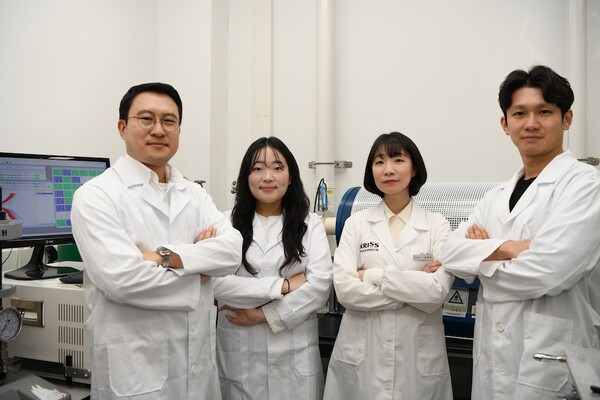
The Korea Research Institute of Standards and Science (KRISS) said on Tuesday it has developed a core materials technology that will accelerate the commercialisation of all-solid-state batteries. All-solid-state batteries are next-generation batteries that use a solid electrolyte instead of a liquid electrolyte, fundamentally blocking fire and explosion risks. The research team cut solid electrolyte production costs to one-tenth of existing levels.
KRISS' Advanced Materials Measurement Group developed a method to coat solid electrolyte powder with a multifunctional compound. The technology produced an ultra-high-density, large-area solid electrolyte membrane. Lithium-ion rechargeable batteries currently used in electric vehicles and energy storage systems (ESS) use a flammable liquid electrolyte.
Oxide-based all-solid-state batteries use garnet-based solid electrolytes as a material, but lithium evaporates when powder is pressed at ultra-high temperatures of at least 1,000 degrees Celsius, despite the material's ionic conductivity and chemical stability. That reduces the membrane's structural stability, making it difficult to manufacture large areas. Changes in chemical composition also degraded quality, including ionic conductivity and interfacial resistance.
As a result, manufacturers previously protected the electrolyte membrane by covering it thickly with a large amount of a lithium-electrolyte material called mother powder. The amount of mother powder discarded after sintering, as a single-use material, was more than 10 times the amount of electrolyte membrane produced, raising unit costs.
The team developed a manufacturing technique that applies a thin layer of a functional lithium-based compound to the surface of solid electrolyte powder. The surface coating layer supplies lithium during sintering and prevents lithium evaporation. A soldering effect that increases bonding strength between particles maximised the membrane's density.
The team achieved a density of at least 98.2 percent, described as the world's highest level, without using any mother powder. It also more than doubled ionic conductivity while cutting the solid electrolyte membrane's electrical conductivity by more than 20 times, lowering the risk of current loss inside the battery, it said. It also stressed it manufactured a large-area solid electrolyte membrane with an area of 16 square centimetres, more than 10 times larger than existing products, with a yield of 99.9 percent.
Seungwook Baek, a principal researcher at KRISS' Advanced Materials Measurement Group, said, "This achievement completely solved difficult materials and manufacturing process challenges that had remained unresolved for more than 20 years in garnet-based solid electrolyte research." He said, "Since we have drastically lowered production costs, we will greatly accelerate the commercialisation of oxide-based all-solid-state batteries and lead technological innovation in the ESS and electric vehicle markets."
Hwajeong Kim, a postdoctoral researcher at the group, said, "Currently, South Korea imports all garnet-based solid electrolyte pellets, which are 1 cm in diameter and cost more than 800,000 won." She said, "This technology development will be an opportunity to open the way for domestic production of high-value next-generation battery materials."
The research was supported by the Ministry of Science and ICT and the National Research Foundation of Korea through a nano and materials technology development programme and was published in the January issue of Materials Today.
 Daegeon Seok
d2dg@d-today.co.kr
Daegeon Seok
d2dg@d-today.co.kr