
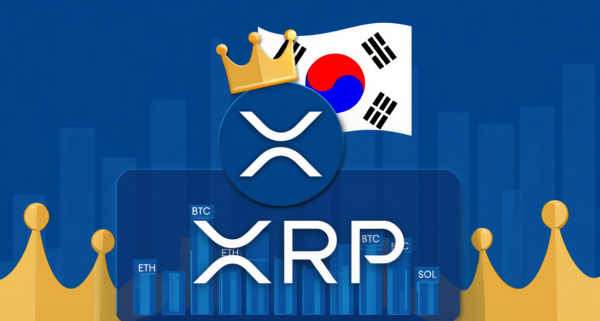
An assessment has emerged that XRP has established itself as one of the core trading assets on Upbit in South Korea's cryptocurrency market.
On June 9 local time, blockchain outlet The Crypto Basic reported that Evernode CEO Ashish Birla (애시시 벌라) described South Korea as “a mature digital asset market where XRP trading volume exceeds bitcoin,” after recently attending the Bitcoin Seoul event.
Birla said Upbit’s XRP/KRW market consistently remains among the top ranks. He said XRP trading volume sometimes exceeds that of bitcoin and ether when market volatility rises. As of now, XRP/KRW trading volume on Upbit ranked third at about $89.64 million. BTC/KRW was fourth at $72.48 million, while ETH/KRW was seventh at $43.02 million.
A change in the stance of South Korea’s financial sector was also cited as a notable trend. Birla said large South Korean financial institutions no longer view cryptocurrency as an experimental industry and are actively investing in infrastructure that supports the digital asset ecosystem.
Bitcoin Seoul was a bitcoin-focused event, but discussion of tokenisation and real-world assets was more prominent at the venue, it was also noted. This indicated substantial interest in ways to digitise tokenised government bonds, intellectual property and other real assets. Birla cited as specific examples Ondo Finance’s tokenised government bond product and SBI Digital Markets’ tokenised music project.
Against this backdrop, Birla said institutions are evaluating blockchain networks based on infrastructure performance rather than brand awareness or community loyalty. He said tokenised assets require high throughput, low costs and fast final settlement. As a result, the key competitive yardstick in the market is emerging as which chain can handle actual institutional demand.
XRP Ledger (XRPL) is also expanding its presence in this market. In the first quarter of this year, the market capitalisation of XRPL-based real-world assets rose 124 percent from the previous quarter to $2.25 billion. The size later increased further to about $3.7 billion, and the number of tokenised assets on the network was tallied at 293.
As South Korea’s strong XRP trading, expanding infrastructure investment by the financial sector and the spread of tokenisation discussions reinforce one another, how far XRPL’s scope of use will expand is emerging as the next point to watch.
Even so, trading volume leadership does not directly mean expanding institutional adoption. For XRP and XRPL to maintain a strong presence in South Korea, it must extend beyond won-denominated trading liquidity to specific use cases such as actual payments, issuance of tokenised assets and inter-institution settlement. Whether South Korean investors’ high interest in XRP can translate into demand for XRPL-based infrastructure remains a variable that will shape future market assessments.
At Bitcoin Seoul this week, one of the most-traded coins in the country wasn't bitcoin. It was XRP. On Upbit, Korea's largest exchange, XRP/KRW consistently ranks among the top traded markets and has repeatedly topped both BTC and ETH on heavy days. Seoul is one of the deepest… pic.twitter.com/nAU0KQJhPH
 Yoonseo Lee
yslee@d-today.co.kr
Yoonseo Lee
yslee@d-today.co.kr