
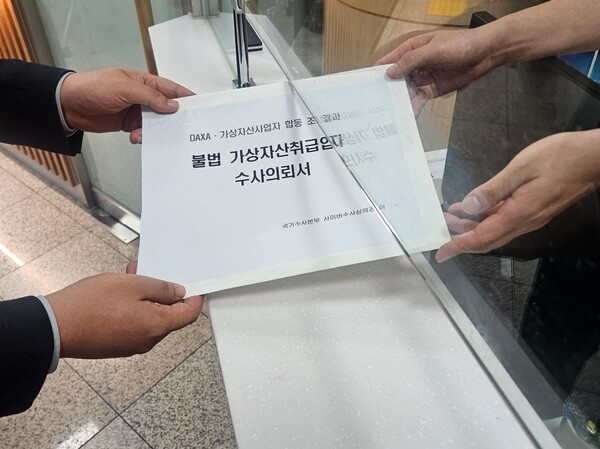
The Digital Asset Exchange Alliance (DAXA) flagged 12 illegal digital asset operators and requested a police investigation. Some were found to have charged fees as much as 62 times higher than domestically reported operators, or to have demanded personal data such as resident registration cards and copies of bankbooks without legal grounds.
DAXA said on Tuesday it uncovered 12 illegal digital asset operators and asked police to investigate, after conducting an "intensive probe into illegal virtual asset operators" for about 3 months from February together with domestically reported virtual asset service providers (VASPs).
The probe was conducted to identify illegal businesses that failed to meet the obligation to report as a digital asset business operator to the Financial Intelligence Unit (FIU) under Article 7 of the Specific Financial Information Act.
DAXA said circumstances were confirmed in which some illegal operators conducted illegal business by exchanging digital assets for won outside the regulated system via Telegram and websites, or by unreported overseas exchanges marketing to Koreans.
Under the act, operating a digital asset business for business purposes without reporting to the FIU can be punishable by up to 5 years in prison or a fine of up to 50 million won.
The probe found circumstances of illegal activity in a total of 12 entities, including 8 illegal over-the-counter exchanges and 4 overseas exchanges operating in the domestic market, such as trading digital assets without reporting under the act.
In particular, the average brokerage fee at the illegal over-the-counter exchanges ranged from at least 1.5 percent to as much as 10 percent. That is as much as 62 times the average fee of 0.16 percent at the five major domestic exchanges.
DAXA explained that there were significant concerns that funds that are difficult to exchange through official methods could move via such high-fee over-the-counter trading and be abused for criminal activities such as drugs and gambling.
Signs of illegal collection of personal information were also confirmed. Some illegal over-the-counter exchanges were found to have demanded personal data such as resident registration cards and copies of bankbooks from users.
Those companies said it was an identity verification process under relevant laws, but because they were not legally reported digital asset business operators, there was potential for violations of the Personal Information Protection Act in relation to the collection of personal data.
Under the Personal Information Protection Act, acts such as using another person's personal information without due authority or beyond permitted authority can be punishable by up to 5 years in prison or a fine of up to 50 million won.
The probe also identified unreported overseas exchanges illegally operating while targeting Koreans. They were found to have supported Korean-language websites and won payments or won-denominated displays, or to have carried out marketing to attract Korean customers.
Unreported overseas exchanges are not included in the scope of management and supervision by financial authorities, meaning they may not have sufficiently established anti-money laundering systems and user protection systems. Users should exercise caution because it may be difficult to obtain compensation even if damage occurs.
In addition, domestically reported digital asset exchanges have an obligation to monitor abnormal transactions under the Act on the Protection of Virtual Asset Users, but unreported overseas exchanges are outside the supervision of financial authorities, which could create blind spots for monitoring unfair trading such as price manipulation.
Kim Jae-jin (김재진), executive vice chairman of DAXA, said, "This probe is the first case in which digital asset business operators that have properly completed domestic reporting acceptance worked together to respond to illegal activities." He said, "We will continue to work to protect users and foster a sound market by standing up to illegal digital asset operators."
 Sangyeop Oh
yub@d-today.co.kr
Sangyeop Oh
yub@d-today.co.kr