
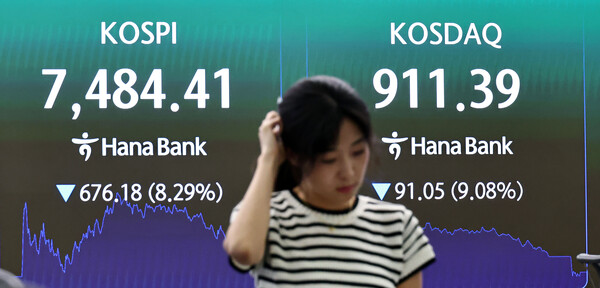
South Korean stocks faced a "Black Monday" on June 8. Rate 부담 from strong U.S. jobs data, Broadcom-driven weakness in chip shares, instability in the won-dollar exchange rate and geopolitical risks in the Middle East combined to send the KOSPI and Kosdaq tumbling. Sell-side sidecars and circuit breakers were triggered in quick succession during the session on the main board and the Kosdaq market.
The KOSPI ended down 676.18 points, or 8.29 percent, at 7,484.41 from the previous session, according to the Korea Exchange. The index opened down 112.50 points, or 1.38 percent, at 8,048.09 and extended losses to fall below the 8,000 mark.
The KOSPI's fall was historically large. Including this session, the KOSPI has fallen more than 8 percent in a day 8 times since 2000.
By magnitude, it was the seventh-largest, following Sept. 12, 2001 (-12.0 percent) after the impact of the Sept. 11 attacks, April 17, 2000 (-11.6 percent) during the IT bubble collapse, and March 19, 2020 (-10.6 percent) amid a COVID-19 liquidity panic.
The Kosdaq also closed down 91.05 points, or 9.08 percent, at 911.39. The index plunged more than 8 percent intraday, triggering a circuit breaker as investor sentiment froze rapidly.
Market stabilisation measures were all activated on the two markets as the selloff deepened. On the KOSPI and Kosdaq, sell-side sidecars were triggered, temporarily suspending the effectiveness of program sell orders as futures prices fell sharply. As losses widened, circuit breakers were triggered on both the main board and the Kosdaq market.
A circuit breaker is a system that temporarily halts trading in the stock market and related derivatives markets to ease shocks when a stock index falls sharply beyond a certain level. A first-stage circuit breaker is triggered when the index remains down 8 percent or more from the previous day for at least 1 minute, halting stock trading for 20 minutes.
The plunge in local stocks was attributed directly to the shock in U.S. markets last Friday. U.S. May nonfarm payrolls far exceeded market expectations, reigniting worries about rate hikes, while weak Broadcom earnings guidance and semiconductor-related noise combined to spread selling across chip stocks. In U.S. trading, the Nasdaq index fell in the 4 percent range and the Philadelphia Semiconductor Index slid in the 10 percent range.
South Korean stocks, which rely heavily on large chip names such as Samsung Electronics and SK Hynix, were hit hard by the slump in U.S. semiconductor shares. Profit-taking concentrated on the semiconductor rally that had recently driven the KOSPI higher, amplifying the index decline. Samsung Electronics fell in the 10 percent range and SK Hynix dropped in the 7 percent range, weighing on the index.
Flows were also fragile. On the KOSPI, retail investors were net buyers of 1.7633 trillion won, while foreigners and institutions were net sellers of 373.8 billion won and 1.6269 trillion won, respectively. Foreigners extended net selling on the KOSPI for 21 consecutive sessions, adding to the index burden.
On the Kosdaq, foreigners were net buyers of 279.7 billion won, while retail investors and institutions were net sellers of 124.6 billion won and 146.5 billion won, respectively. In June, foreigners posted net buying on 3 of 5 sessions, but the Kosdaq faced the risk of breaking below 900 as the lack of leadership flows combined with risk-off sentiment.
At one point in the morning, bargain hunting lifted the KOSPI above 7,800. News spread that Nvidia Chief Executive Jensen Huang (젠슨 황) had called this week's stock decline a buying opportunity, suggesting losses might narrow. But volatility picked up again in the afternoon as uncertainty tied to the Middle East resurfaced, including an urgent statement by Yemen's Houthi rebels and reports of Iran firing missiles at Israel.
Some stocks, however, showed differentiated moves. NAVER rose as expectations grew for infrastructure cooperation based on South Korea's first gigawatt-class AI factory. SK Networks also hit the daily limit on expectations tied to AI cloud operations.
Telecom shares were supported by their defensive characteristics and expectations for AI factory cooperation. Steel pipe shares reflected expectations of stronger U.S. anti-dumping regulations on oil well steel pipes and an industry recovery. Space-related shares drew buying interest in some names ahead of SpaceX's Nasdaq listing.
Some in the brokerage industry viewed the plunge as a correction driven by the unwinding of short-term overheating and a flow shock rather than a structural crisis. U.S. jobs data and semiconductor noise stirred rate and flow instability, but analysts said the earnings outlook for South Korean semiconductors itself had not been damaged.
Hwang Su-wook (황수욱), a researcher at Meritz Securities, analysed the move, saying, "Amid short-term overheating concerns, multiple adjustment triggers emerged at the same time," and adding that "rates, concerns about the AI industry, futures and options expiration, and flows acted as factors that widened losses."
Lee Jae-won (이재원), a researcher at Yuanta Securities, cited past cases in which the KOSPI plunged more than 8 percent in a day and said watching on the sidelines was needed rather than panic selling.
He explained, "Since 2000, there have been a total of 7 cases in which the KOSPI fell more than 8 percent in a day, and except for cases where system risk spread to a real-economy downturn such as the 2008 financial crisis, most rebounded sharply."
 Sang-yeop Oh
yub@d-today.co.kr
Sang-yeop Oh
yub@d-today.co.kr