
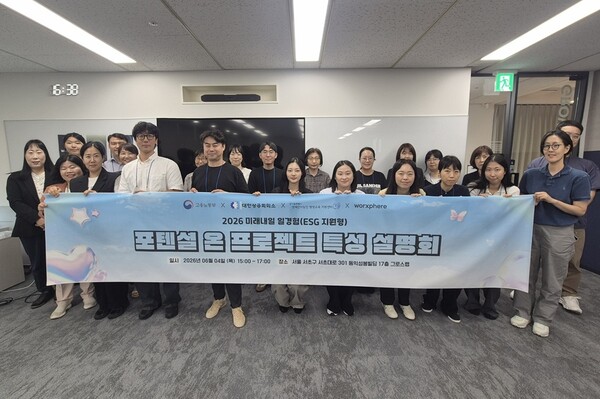
AI and data-based HR tech platform Worksphear held a briefing session to provide work experience opportunities for young adults with borderline intelligence.
The session, held on June 4 at Worksphear’s headquarters in Seoul, was attended by about 30 people, including HR managers, mentors and accompanying coaches from 8 workplaces in the first cohort of the 2026 Future Tomorrow Work Experience programme.
At the briefing, Jin-sook Jang (장진숙), a team leader at the Seoul Lifelong Education Support Center for People with Borderline Intelligence (Mim Center), a Seoul City Hall consigned institution, gave a lecture on understanding young adults with borderline intelligence. She introduced ways to collaborate based on their cognitive and communication characteristics and shared operational know-how. Young-cheol Seo (서영철), CEO of Freewail, presented with a focus on real cases of working with young adults with borderline intelligence.
Worksphear is jointly operating the 2026 Future Tomorrow Work Experience (ESG) project this year with the Mim Center, a programme hosted by the Ministry of Employment and Labor and the Korea Chamber of Commerce and Industry.
The project includes participating companies and institutions such as Kyobo Book Centre’s One Grove branch, Gangbuk District Office’s Gangbuk Smart Farm, Giving Plus’s Meokgol Station and Yangjae Station branches, the Hope Value Incorporated Association (Seoul Youth Center), Hope Workplace’s Hope Cafe, HM Co Ltd, and the Beautiful Store’s Songpa Garak branch. They will provide work-experience opportunities to a total of 16 young adults.
Seung-il Jung (정승일), head of Worksphear’s career business division, said it was meaningful to help create a path for young adults with borderline intelligence to take their first steps into society. He said participating companies can also gain valuable experience by practising sincere ESG management. Jung said Worksphear plans to offer work-experience opportunities in a variety of roles based on each young person’s capabilities and disposition, and he hoped more companies would join as workplaces for the second and third cohorts.
 Chi-gyu Hwang
delight@d-today.co.kr
Chi-gyu Hwang
delight@d-today.co.kr