
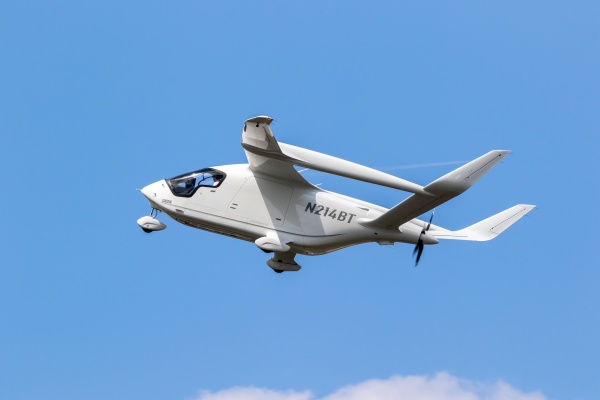
[Digital Today reporter Jinju Hong] U.S. electric aviation startup Beta Technologies is stepping up efforts to commercialise its Alia CX300 electric aircraft aimed at short regional routes. As competition to commercialise electric vertical takeoff and landing aircraft intensifies, Beta is seeking differentiation with a strategy of first bringing runway-based conventional takeoff and landing electric aircraft, or cTOLs, to market.
Business Insider reported on June 6 that Beta Technologies plans to start paid cargo operations using the Alia CX300 within this year. The flights will operate under a U.S. Transportation Department pilot programme, and the company is targeting late 2027 to obtain full commercial operating certification.
The Alia CX300 is an electric aircraft that takes off and lands on a runway. It can carry up to 6 people including the pilot, and can fit up to 5 battery packs under the fuselage to store about 250 kWh of power. Under ideal conditions, it can fly about 390 miles, or about 628 km.
Another feature is a redundant design that allows the aircraft to continue flying even if one battery pack has a problem, to improve safety. The company sees the structure as a key competitive strength in the certification process.
Beta Technologies has already secured orders from major customers including Air New Zealand. It has also designed its business strategy in phases. It plans to expand from cargo cTOL aircraft to passenger cTOLs, then cargo eVTOLs, and then passenger eVTOLs.
Kyle Clark (카일 클라크), Beta Technologies' chief executive officer, said, "A cargo cTOL aircraft is ready today," adding, "The next step is a passenger cTOL, and then we will expand to vertical takeoff and landing aircraft."
That differs from rivals Joby Aviation and Archer Aviation, which are focusing on commercialising eVTOLs. Beta chose a strategy of first establishing cTOLs in the market, which it sees as relatively less difficult to certify, to build up technology and operating experience.
The company also highlights the operating cost savings it says electric propulsion systems can deliver. Test pilot Chris Caputo said the electricity cost used for actual flights was only a few dollars. Beta said a recent demonstration flight carrying U.S. Transportation Secretary Sean Duffy also cost about $3.
That compares with fuel costs of hundreds of dollars for similarly sized fuel-powered light aircraft. Still, the industry views electricity savings as unlikely to translate directly into cheaper airfares, as many operating costs remain, including pilot labour, maintenance, insurance and the costs of building charging infrastructure.
Battery replacement costs are also a variable. Documents the company submitted to the U.S. Securities and Exchange Commission showed battery replacement demand over the aircraft's life cycle could reach as much as $13 million.
Beyond aircraft sales, Beta is also developing charging infrastructure as a new revenue source. Its in-house fast charger can charge an aircraft in about 1 hour and is priced at hundreds of thousands of dollars. Beta aims to secure quality and cost competitiveness through a vertical integration strategy in which it develops key technologies in-house, including propulsion systems and charging equipment.
Operational validation is also under way. Beta is conducting test flights in cooperation with Republic Airways, Air New Zealand and the UK's Loganair. With Air New Zealand, it built operating data earlier this year by flying more than 7,000 miles across 12 airports in more than 100 flights.
Beta is targeting regional airports that are difficult for large jets to serve. In the United States, there are more than 4,000 public airports where large commercial aircraft do not operate. The company expects the Alia CX300 to connect these short regional routes and create new markets.
The industry is watching whether Beta's strategy can become a practical commercialisation model for the electric aviation sector. Attention is focused on whether its plan to build a track record in cargo transport and regional air services, then ultimately expand into the urban air mobility market, will translate into results.
 Jinju Hong
hongjj@d-today.co.kr
Jinju Hong
hongjj@d-today.co.kr