
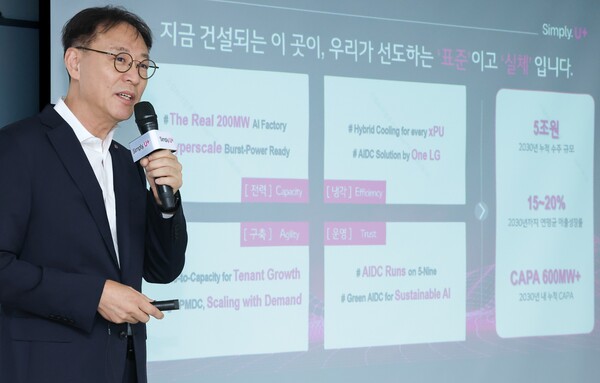
LG Uplus is expanding its artificial intelligence data centre infrastructure business in earnest. Working with group affiliates, it aims to target the next-generation AI infrastructure market and achieve 5 trillion won in cumulative orders by 2030.
LG Uplus on June 5 announced its next-generation AI infrastructure strategy and shared its plans at the construction site of its AI data centre in Paju, Gyeonggi Province.
◆ Strengthening AI data centre competitiveness with 'The ACE on Trust'
LG Uplus is accelerating efforts to advance its data centres through its 'The ACE on Trust' strategy. The ACE on Trust reflects an approach to deliver Agility, meaning build speed, Capacity, meaning power and scale, and Efficiency, meaning cooling efficiency, on top of Trust, meaning operational stability for data centres.
The AI data centre market has recently seen power consumption and heat generation surge as the focus of AI workloads shifts from training to inference. The gap between AI infrastructure demand and supply has also widened as data centre build speed fails to keep pace with advances in graphics processing unit (GPU) performance.
LG Uplus will introduce a prefabricated modular data centre (PMDC) method to speed up data centre construction. PMDC standardises key facilities, prefabricates them and then assembles them on site. The company said it can flexibly scale from small proof-of-concept (PoC) projects to hyperscale size and can cut construction time by several months or more compared with existing methods.
The Paju AI data centre, with a total floor area of 150,000 square metres, is also boosting construction speed by applying methods such as assembling prefabricated key structures on site. LG Uplus plans to build a foundation that can respond to AI infrastructure demand in a timely manner.
◆ Securing 200MW of power... operating an inference-focused AI data centre
Power infrastructure was also presented as a core competitive strength. The Paju AI data centre has secured a confirmed power supply of 200MW and is set to operate as the largest inference-focused AI data centre in the Seoul metropolitan area. LG Uplus said Paju is currently the only AI data centre in the metropolitan area capable of being supplied with 200MW.
LG Uplus has secured large-scale power infrastructure in the metropolitan area, including its existing Pyeongchon centres 1 and 2. In addition to building its own facilities, it will also provide customised supply based on design, build and operate (DBO) through cooperation with global partners and asset management companies.
The Paju AI data centre will be built as a hybrid structure that supports both air cooling and liquid cooling at hyperscale level for the first time in South Korea. From the construction stage, it was designed to optimise liquid cooling by configuring building loads, waterproofing and piping to respond to heat generated by inference-focused GPU servers.
In particular, the liquid cooling facilities built in cooperation with LG Electronics adopt a direct-to-chip (D2C) method that attaches a dedicated metal plate to GPU chips and circulates liquid through a coolant distribution unit (CDU) to remove heat directly. LG Uplus said its in-house verification confirmed an energy efficiency improvement of about 24 percent compared with existing air cooling.
◆ Shifting to an AI factory operator... expecting One LG synergy
LG Uplus said it has accumulated uninterrupted data centre operating capabilities at the 99.999 percent level over 27 years. The Paju AI data centre will use robots to strengthen stability through 24 hours a day, 365 days a year checks of temperature and humidity, leaks and dust, and through monitoring of the outer site.
LG Uplus plans to shift beyond being a simple builder and lessor of data centres to an 'AI factory operator'. Its goal is to become an infrastructure provider that helps AI operate in an optimal environment by managing GPU resources and operating elements such as power and cooling in an integrated way, like a factory.
Ahn Hyung-gyun (안형균), executive director and head of LG Uplus' Enterprise AI Business Group, said AI data centre competitiveness depends not on facility size but on how stably an operator can run the overall infrastructure. He said the Paju AI data centre will be a representative case showing that capability.
Key equipment at the Paju AI data centre, including cooling facilities, batteries and power equipment, will be built based on the 'One LG' ecosystem. In cooling, LG Electronics will produce an air-cooled free-cooling chiller that makes cooling water, in addition to the coolant distribution unit and the D2C liquid cooling solution.
High-performance uninterruptible power supply (UPS) batteries from LG Energy Solution will also be applied. The batteries immediately correct power during outages or voltage fluctuations and minimise fire and thermal runaway risks through a multi-layer safety structure designed in-house from battery cell to pack. The DC 800V power distribution system to respond to high power usage will be jointly developed with LS Electric.
LG Uplus is also developing its own AI-based data centre infrastructure operations system to manage these pieces of equipment in an integrated way.
Based on its next-generation AI data centre strategy, LG Uplus plans to achieve 5 trillion won in cumulative orders by 2030 and grow average annual revenue by about 15 to 20 percent. Building 1 of the Paju AI data centre, scheduled for completion in June next year, has already completed all contracts.
Ahn said the Paju AI data centre is AI infrastructure that integrates cooling, battery and power facilities and operational capabilities through 'One LG' synergy. He stressed that LG Uplus is also contributing to securing competitiveness for domestically produced equipment through the Paju AI data centre.
 Jin-ho Lee
jhlee26@d-today.co.kr
Jin-ho Lee
jhlee26@d-today.co.kr