
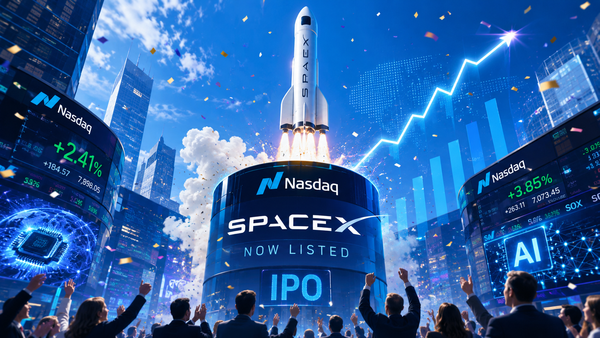
[DigitalToday reporter Sangyeop Oh] The fallout from a sharp drop in U.S. semiconductor shares and supply-demand variables ahead of a SpaceX listing have emerged as factors for the domestic stock market this week. The KOSPI is maintaining a record-high trend, but the potential for increased volatility has grown as concentration in semiconductors and fatigue from a short-term surge have built up.
U.S. stocks swung sharply after a steep fall in semiconductor shares. On June 5 (local time) in New York, the Dow Jones Industrial Average ended at 50,866.78, down 695.15 points, or 1.35 percent, from the previous session.
The S&P 500 fell 200.63 points, or 2.65 percent, to 7,383.68. The Nasdaq index closed down 1,121.53 points, or 4.18 percent, at 25,709.43.
The Philadelphia Semiconductor Index slumped 10.3 percent. The move came as a view spread that growth in Broadcom's AI semiconductor business fell short of market expectations, while strong U.S. May jobs data increased worries about interest rate hikes. Nvidia fell about 6 percent, Micron dropped 13 percent and AMD slid 11 percent.
The domestic market also looks unlikely to avoid the impact. With Samsung Electronics and SK Hynix having led the KOSPI's recent rise, a correction in U.S. chip shares could weigh on investor sentiment early in trading on June 8. Still, some see the plunge not as the end of a chip bull market but as a process of cooling short-term overheating.
The KOSPI has recently moved to a higher level, but intraday volatility has also increased. As of June 2, it rose 6.96 percent over the week to 8,801.49 from 8,228.70.
Volatility remained high due to the short-term surge, heavy concentration in semiconductors and a stalemate in U.S.-Iran talks. VKOSPI, the KOSPI 200 volatility index, also rose above 70 points, reflecting market anxiety.
Fund flows are also hard to describe as stable. From May 28 to June 3, foreigners were net sellers of 12.9 trillion won on the KOSPI. Individuals and institutions were net buyers, absorbing the foreign selling.
Foreign investors were net sellers of semiconductors worth 11.1 trillion won, while institutions were net buyers of semiconductors worth 5.3 trillion won. That suggests a clear split in views among investor groups over semiconductors.
The first hurdle next week is U.S. inflation data. The U.S. May consumer price index (CPI) is released on June 10 and the producer price index (PPI) on June 11. Markets say if inflation comes in higher than expected, worries about interest rate hikes could grow again. That could weigh on growth stocks, semiconductors and the KOSDAQ.
A SpaceX listing expected on June 12 is also a supply-demand variable. The market is watching the possibility that SpaceX could become one of the largest initial public offerings (IPO) on record. Its expected valuation is discussed at about $1.75 trillion to $1.77 trillion.
Concerns are emerging that as global investors raise funds for SpaceX subscriptions and post-listing buying, profit-taking pressure could increase on Korean AI and semiconductor leaders that have risen strongly in recent weeks.
Some analysis says, over the medium to long term, a SpaceX listing could become a new opportunity for South Korea's semiconductor sector. That is because SpaceX is expanding beyond an aerospace company into a data infrastructure company linking the ground and space. If discussions on building space data centers and AI infrastructure become reality, demand for high-performance memory could rise.
The industry sees the stock market in June as likely entering a phase of moderating pace rather than trend damage. Semiconductors remain the key leading sector, but the pace of share gains through May was fast, and a gap in upgrades to earnings forecasts could appear until the second-quarter pre-earnings season. As a result, advice is emerging that holding positions and responding to pullbacks is more appropriate than chasing prices.
Investors should also check for rotation into non-semiconductor sectors. Shipbuilding, staples, cosmetics and apparel, healthcare, banks and some telecom sectors, which move differently from semiconductors and have less price burden, could play a complementary role. Defense and securities may also draw interest for earnings momentum and benefits from higher trading value, respectively.
Ultimately, the starting point for this week's market is expected to be how much it absorbs the shock from the U.S. chip plunge on June 8. After that, the direction of the index could change depending on the schedule that runs through CPI on June 10, PPI on June 11 and the SpaceX listing on June 12.
If inflation stays within the expected range and the semiconductor adjustment is limited, the KOSPI could try to rise again. If interest rates and fund-flow pressures increase at the same time, a short-term pullback is unavoidable.
Jong-min Kim (김종민), senior research fellow at Samsung Securities, said, "This bout of shaking is an inevitable pause for breath in the course of a rally in leading stocks, not a structural break from the trend," and "there is a need to maintain positions centered on core leaders without being swayed by short-term volatility."
 Sangyeop Oh
yub@d-today.co.kr
Sangyeop Oh
yub@d-today.co.kr