
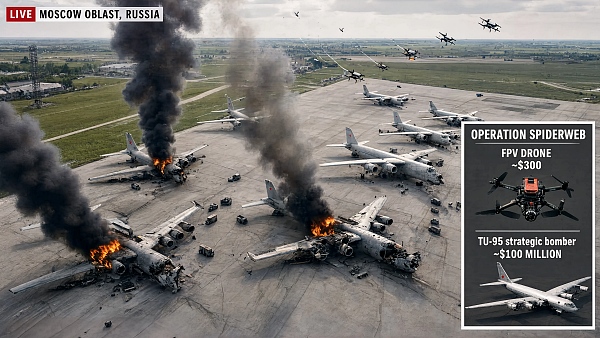
Ukraine's Operation Spiderweb, in which it used 117 drones to simultaneously disable 41 Russian fighter jets, marks its first anniversary, tech outlet TechRadar reported on Thursday local time.
The operation is regarded as one of the most successful drone attacks on record. Ukraine estimates the damage at about $7 billion, and the targets were spread across 5 air bases inside Russia. The deepest strike hit the Belaya base in eastern Siberia, about 4,300 km from Ukraine.
Preparation alone took 18 months. The drones were smuggled into Russia as parts, assembled locally and hidden in mobile cabins on trucks before being activated remotely through Russia's cellular networks. The plan was designed to minimise exposure of local operators.
Ukraine estimates Russia's losses at $7 billion. Up to 41 aircraft were tallied as damaged at 5 air bases in Russia. Countries not directly involved in the military conflict are also paying attention to the power of asymmetric attacks.
Military experts compare the operation to a Russian version of the Pearl Harbor attack. Iran's mass-produced Shahed drones cost about $20,000 each, and the operation delivered a shock by demonstrating that military assets worth billions of dollars can be neutralised at extremely low cost.
The United States is also watching the operation closely. The U.S. military operates 4,790 military facilities worldwide, including 824 major bases at home. It also keeps 11 aircraft carriers deployed at all times. The United States is introducing laser, microwave and electronic warfare-based counter-drone systems and reinforced hangars, but analysts say a shift in doctrine beyond simple countermeasures is inevitable as drones become smaller and more intelligent.
The core lesson from Ukraine's Operation Spiderweb is that the "inside of the defensive line" is no longer safe. Most military defence systems are designed on the assumption of external threats, but the operation shattered that premise by bringing drones inside for assembly and striking from within. It means expanding counter-drone equipment alone is not enough.
Calls are growing to redesign overall operating practices, including tighter controls on supplies and personnel entering bases, blocking use of civilian communications networks and dispersing high-value assets. In an era when a low-cost drone can take on a fighter jet worth hundreds of millions of dollars, Ukraine is showing that military superiority is no longer guaranteed by the scale of assets alone.
 Hyunwoo Choo
cookinpapa@d-today.co.kr
Hyunwoo Choo
cookinpapa@d-today.co.kr