
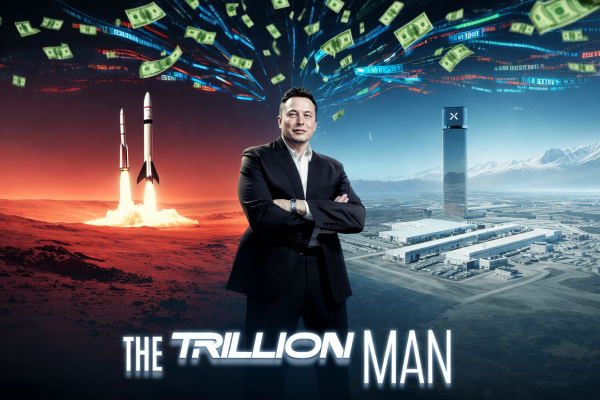
With SpaceX's initial public offering (IPO) approaching, the likelihood is growing that Elon Musk (일론 머스크) could see his net worth surpass $1 trillion. At the same time, controversy is widening over the concentration of Musk's voting rights, relaxed rules for index inclusion and limits on shareholder rights.
On June 3 local time, foreign media outlets including CNBC and The Verge reported that SpaceX presented an offer price of $135 a share in an amended prospectus. Based on that, the company is valued at about $1.77 trillion. The market is also discussing the possibility that SpaceX could enter the stock market as a mega-listed company valued at around $2 trillion.
On that basis, the value of Musk's SpaceX stake comes to $866.5 billion. Adding Tesla holdings worth about $355 billion and option value estimated at more than $100 billion, Musk's net worth could exceed $1 trillion.
The SpaceX listing is a major IPO Musk is pursuing 16 years after Tesla's listing. Even after the listing, Musk is expected to retain more than 80 percent of SpaceX voting rights. Critics say the ultra-multiple voting share structure could place board composition, compensation and key decisions within Musk's sphere of influence.
Controversy also surrounds 1.3 billion restricted shares Musk received this year. The compensation is linked to long-term goals such as creating a Mars colony of 1 million people and building a space data centre. However, it is reported to be structured so that voting rights can be exercised even before the goals are achieved.
In the risk factors section of the prospectus, SpaceX explained that Musk's large stake is an economic incentive that supports the company's success. However, after the 366-day lock-up period ends, Musk has no obligation to keep holding his stake. It specified that he could then sell all or a substantial portion, or reduce his ownership.
The method of index inclusion is also controversial. It usually takes about 90 days for inclusion in major indices, but SpaceX is reported to have had rules relaxed to allow it to enter the Nasdaq 100 in 15 days. In that case, index funds tracking the Nasdaq 100 would have to add SpaceX shares regardless of their investment judgment.
Limits on shareholder rights have also come under scrutiny. It is reported to include a structure in which shareholders must follow arbitration procedures rather than typical shareholder litigation, even if they raise issues such as securities law violations or fraud. That is why concerns are being raised that investor checks could remain limited even after listing.
On performance, Starlink emerged as a key revenue source. Starlink posted revenue of $11.4 billion last year, and SpaceX's total revenue was tallied at $18.67 billion. In contrast, the artificial intelligence (AI) division posted a loss of about $6.4 billion, and NASA launch contracts also recorded a loss of $657 million.
Even so, SpaceX presented AI as a new growth axis, citing an enterprise AI market of $22.7 trillion and a total market of $28 trillion. Some investors believe Musk could later pursue a merger of SpaceX and Tesla to integrate AI resources and improve fundraising efficiency.
The listing documents also revealed details of X's performance. X saw revenue and user growth stagnate, and major indicators fell overall. Data-licensing revenue from AI companies, however, has increased. The fact that Musk gained control over algorithms and exposure structures after acquiring X is also being cited in connection with the control controversy.
If SpaceX lists at a level close to its planned valuation, Musk would have two companies, Tesla and SpaceX, among the group of U.S. mega-companies. However, its revenue scale differs widely from existing big tech companies. Meta's revenue last year exceeded $200 billion, while Tesla posted about $95 billion.
This IPO is both an opportunity to gauge whether Musk's personal wealth can surpass $1 trillion and the first test of SpaceX as it seeks market validation as a mega-listed company. Starlink's profitability and expectations for AI growth were presented as grounds for a rise in valuation, but controversy remains over the concentration of voting rights, the index inclusion method and limits on shareholder rights.
 Yoonseo Lee
yslee@d-today.co.kr
Yoonseo Lee
yslee@d-today.co.kr