
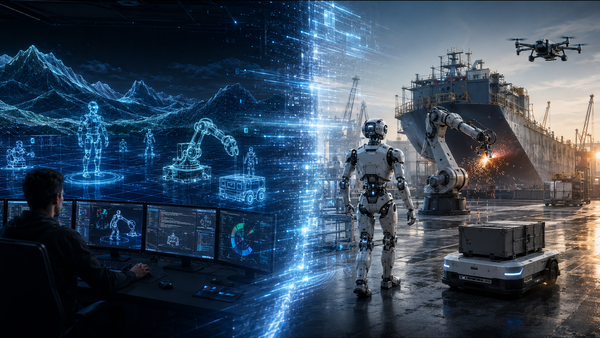
[Digital Today reporter Hojeong Lee] The game industry’s artificial intelligence strategy is expanding beyond improving the efficiency of game production to the broader industry. In particular, it is increasing cooperation with outside companies in physical AI, which is applied to robots, autonomous driving, defence, and manufacturing and shipbuilding sites, as it explores commercialisation potential.
Physical AI is AI applied to systems that move in the real world, such as robots, self-driving cars, factories and logistics facilities. While generative AI centred on text and images has mainly operated in digital environments, physical AI must understand physical laws, space and environmental changes and decide actions on its own. Simulation technology that repeatedly trains in a virtual environment similar to the real world is seen as a key competitive edge. Game companies are assessed as having physics-based simulation capabilities required across game development, such as character movement and collisions, terrain changes and NPC behaviour design, that align with the technology for building training environments for robots and unmanned systems.
NC AI is putting a “world model” at the centre. It is a technology that allows AI to learn and predict physical laws and environmental changes in the real world and connect them to robots’ decision-making ability. It focuses on reducing a key physical AI challenge, the “Sim-to-Real Gap”, in which robots trained in virtual settings malfunction in the face of unexpected variables on real sites. According to NC AI, a lightweight world model the company unveiled in March delivered comparable performance using 25 percent of the GPU resources of the top-performing global model.
In May, NC AI formed a consortium with Hyundai Rotem and was selected as the operator of a national project ordered by the Agency for Defense Development for a “physical AI-based integrated simulator and modular robot system”. The project aims to build a system that integrates the operation of drones and unmanned vehicles on future battlefields, and NC AI is responsible for developing the world model.
It is also expanding cooperation into industrial sites. NC AI has begun jointly developing a robotics foundation model for manufacturing sites with POSCO DX. NC AI will advance a VLA model that integrates processing of vision, language and action, while POSCO DX will build a digital twin-based test environment.
It has also expanded into shipbuilding. NC AI said on June 4 it won an assignment from Hanwha Ocean to develop a “vision-recognition-based welding-only model and a collaborative-robot-based autonomous welding model”. The assignment is a project that combines AI vision recognition and robot control technologies for welding, a core process in shipbuilding. The goal is to move beyond existing automation that repeats fixed trajectories so that robots recognise welding areas and determine welding conditions suited to the situation. The developed system is expected to be applied to Hanwha Ocean’s commercial and special-purpose shipbuilding processes in the future.
Krafton’s approach is different. Rather than making hardware itself, it combines its AI and software capabilities with companies that hold real industrial data. Krafton set up a robotics research unit, Ludo Robotics, in the United States last year and established a South Korean unit in February. Chief Executive Changhan Kim (김창한) and Chief AI Officer Kangwook Lee (이강욱) are leading the organisation. On March 13, it signed a memorandum of understanding with Hanwha Aerospace to jointly develop physical AI technology and establish a joint venture, and it also decided to participate in a $1 billion AI, robotics and defence industry fund being set up by Hanwha Asset Management.
In late April, it also decided to participate in a 150 billion won autonomous driving new entity being pushed by Socar. Krafton made a strategic investment of 65 billion won in Socar and will also participate as a separate investor in the new entity. Socar built a data pipeline that collects about 1.1 million km of real-world driving data per day based on a car-sharing fleet of 25,000 vehicles in the first quarter of this year. It also secured edge-case data needed to train autonomous driving AI, including as many as 220,000 accident data points. Krafton plans to use such real-road data for physical AI research.
The two companies’ motivations differ. Krafton is making physical AI a new growth axis as it needs a new growth narrative after “Battlegrounds” despite strong results. For NC, physical AI is closer to a task of proving its own revenue as an independent company, after it spun off its AI organisation to make NC AI independent amid shakiness in its core game business. Still, the logic behind choosing physical AI overlaps. Large-scale game development is hard to guarantee success even after years of time and massive costs. In contrast, B2B-based physical AI businesses in defence, manufacturing and shipbuilding require early validation and securing references, but once on-site application cases are created, there is room to expand into long-term cooperative relationships.
For game companies, physical AI is a field where technical strengths and business needs align at the same time. It has the character of reshaping business portfolios, not simply entering a new business, because it can reuse existing technologies while creating a revenue structure different from games.
An industry official said, “Virtual world implementation technology that game companies have built up over decades is serving as stronger competitiveness in the physical AI market than expected,” adding, “By moving with an eye on the potential for industrial expansion of technology assets rather than short-term performance, it could be an inflection point where the business structure of game companies fundamentally changes.”
 Hojeong Lee
lhj@d-today.co.kr
Hojeong Lee
lhj@d-today.co.kr