
Credit loans have risen by the most in about five years, and higher lending rates are adding to concerns about the interest burden on borrowers who invest using debt. With Bank of Korea Governor Shin Hyun-song (신현송) publicly mentioning the need to raise the policy rate, the market is also forecasting that rate hikes could begin as early as July. With the top end of credit-loan rates already above 6 percent a year, a full-fledged upturn in rates could leave borrowers facing investment losses and interest costs at the same time.
As of June 4, the financial sector said outstanding credit loans at the five major banks — KB Kookmin, Shinhan, Hana, Woori and NH Nonghyup Bank — rose by more than 2.6 trillion won in May from a month earlier. It marked the biggest increase in 5 years and 1 month since April 2021, when the KOSPI climbed above 3,200. It is an unusual expansion given recent monthly increases of around 1 trillion won.
The increase appears to have been led by minus-account loans. Banks see the fact that the balance did not fall even at month-end as suggesting some funds may have been linked to demand for stock market investment.
A possible shift in the Bank of Korea's monetary policy is one factor adding to rate burdens.
The central bank's Monetary Policy Board kept the policy rate unchanged at 2.50 percent a year on May 28, but the possibility of rate hikes ahead has become clearer.
Shin said a policy rate hike is needed at an appropriate time given inflation and growth, the exchange rate and the real estate situation. Most board members' projections for the policy rate over the next six months also clustered above the current level.
The bond market is also reacting to the central bank's tightening signals. The one-year bank bond yield, which affects how credit-loan rates are set, rose to 3.453 percent a year at the end of last month, the highest in 23 months. The five-year financial bond yield, a benchmark for fixed-rate mortgage loans, has also climbed to 4.280 percent a year, the highest since November 2023.
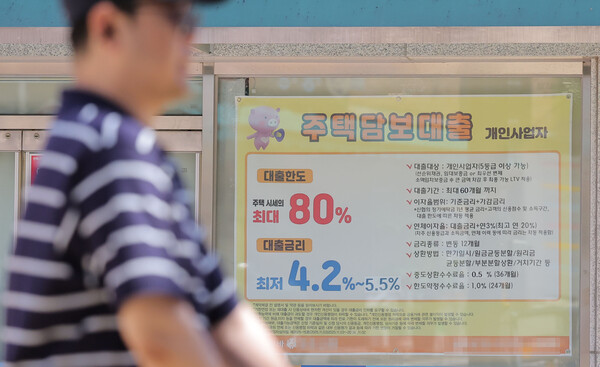
As higher market rates feed into bank lending rates, the top end of credit-loan rates at the five major banks has risen above 6 percent a year. Five-year fixed mortgage rates have also climbed from the mid-4 percent range to the low-7 percent range. Unless banks sharply lower add-on rates, the actual rates applied to borrowers are likely to rise further.
In particular, credit loans and minus accounts have short maturities and reflect rate changes relatively quickly, so the burden felt by debt-investing borrowers could grow more. Borrowing to invest can generate returns when stock market gains exceed interest costs, but if share prices enter a correction, losses and interest burdens can rise at the same time.
The burden could rise not only for debt-investing borrowers but also for household loan borrowers more broadly. If actual lending rates rise by 0.25 percentage point, annual interest burdens for household loan borrowers are estimated to increase by about 3.2 trillion won. That would mean an average annual increase of about 163,000 won per borrower.
Borrowers with a high share of floating-rate loans and investors who use credit loans are more sensitively exposed to changes in rates. For borrowers who took out loans during the all-in borrowing and debt-investing phase 5 years ago and are reaching a rate reset point, or borrowers who used minus-account limits as investment funds, the increase in burden could appear more quickly.
The financial sector views expanding investment by borrowing money as risky in the current environment. That is because in a period of rising rates, borrowers need to consider not only investment returns but also funding costs and repayment capacity. Even if the stock market continues to rise, if lending rates climb quickly, actual returns could fall, and if markets wobble, losses could grow further.
A banking industry official said, "The recent increase in credit loans appears to be a flow linked to investment demand, but in a period of rising rates, the burden can grow faster than expected." The official added, "As we have effectively entered a rate-hiking phase, borrowers should first check the possibility of rate changes and their repayment plans when taking out loans."
 Ji-young Lee
ljy@d-today.co.kr
Ji-young Lee
ljy@d-today.co.kr