
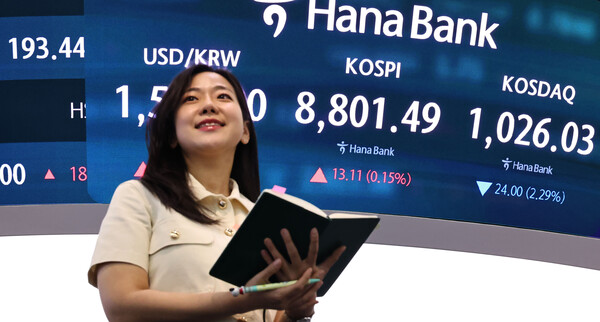
Expectations for a rebound in the Kosdaq grew after the launch of a public-participation National Growth Fund, but the effect did not last long. Growth stocks briefly strengthened on hopes of an inflow of policy money, but market funds have since shifted back into large semiconductor stocks such as Samsung Electronics and SK Hynix.
On June 2, the Kosdaq closed at 1,026.03, down 24.00 points, or 2.29 percent, from the previous session. The intraday low fell to 1,009.75, heightening concerns about a drop below the 1,000 level. It has fallen for five straight sessions since May 27, declining an average 2.63 percent over that period, according to calculations.
The Kosdaq rallied around the launch of the National Growth Fund on expectations of policy benefits, but the trend later changed. Over the past week, foreign investors bought a net 1.4258 trillion won of Kosdaq shares, but institutions sold a net 1.4188 trillion won, adding to pressure on the index. Retail net buying totalled just 784 million won.
In contrast, inflows into the KOSPI continued to focus on large caps. Over the same period, retail investors bought a net 9.3495 trillion won of KOSPI shares and institutions bought a net 3.9978 trillion won. Foreign investors sold a net 13.4477 trillion won, but large semiconductor stocks such as Samsung Electronics and SK Hynix supported the index’s trend.
A concentration in the market is also becoming more apparent. According to the securities industry, the ADR, a market breadth indicator showing the proportion of rising KOSPI stocks, fell to 47.88 percent, its lowest since March 2020.
The index has stayed near its highs, but the number of rising stocks is limited. While large semiconductor shares and some artificial intelligence-related stocks pushed up the index, small and mid-cap stocks and growth stocks were relatively sidelined.
On the day, KOSPI large caps rose 0.3 percent, while KOSPI mid-caps and small caps fell 1.9 percent and 1.3 percent, respectively. Kosdaq large caps, mid-caps and small caps also slid 2.5 percent, 1.9 percent and 2.0 percent, extending weakness across the Kosdaq regardless of market size.
The National Growth Fund is not structured in a way that is unfavorable to the Kosdaq. The public-participation National Growth Fund targets investments in 12 advanced strategic industries and related companies, including semiconductors, secondary batteries, vaccines, displays, hydrogen, future vehicles, biotech, AI, defence, robots, content and critical minerals.
The main-purpose investment portion is set at 60 percent or more. It is designed so that 30 percent or more of the amount raised for sub-funds is invested as new inflows into unlisted companies and Kosdaq tech-special listing firms. The portion of main-purpose investments allocated to KOSPI stocks is capped at 10 percent or less. Within the discretionary investment portion of up to 40 percent, however, investments can be made freely.
An institutional-investor National Growth Fund also focuses on revitalising the Kosdaq market. Korea Development Bank and Shinhan Asset Management selected 11 firms as delegated managers for first-round sub-funds in the indirect investment category of the institutional fund.
The indirect investment products are a policy fund to be formed at a total 규모 of 5.85 trillion won to support domestic advanced strategic industries and the venture and innovation ecosystem.
The selected managers will oversee 3.9 trillion won across seven areas, including Kosdaq market revitalisation, mergers and acquisitions, and AI semiconductors. Financial authorities plan to select managers for an additional second-round 사업 worth 1.6 trillion won and complete fund formation by year-end to channel policy money into the market.
Still, some assess that policy expectations will not immediately lead to a broad-based improvement in Kosdaq flows. That is because policy money is unlikely to buy all stocks and is more likely to flow selectively into companies with demonstrated growth potential and a rationale for fundraising.
Some stocks aligned with policy direction and industry growth potential, such as AI, robots, biotech, advanced equipment and defence, may see improved sentiment. It may take time for that to translate into a broad rise across the Kosdaq, in this view.
Policy momentum after the local elections is also cited as a variable. The securities industry says that, with multiple systems designed in the first half to supply risk capital, election results could change the strength and direction of efforts on remaining capital-market revitalisation tasks such as a Kosdaq second league, tighter delisting rules and shareholder-friendly tax reforms.
The industry also gives weight to the possibility that a market led by large semiconductor stocks will continue for the time being. As AI investment expands, demand for high-bandwidth memory and high-capacity memory rises, and Samsung Electronics and SK Hynix are emerging as key beneficiaries in the process.
Han Ji-young (한지영), a researcher at Kiwoom Securities, said, "In this bull market, since May through June so far, the KOSPI has surged while the Kosdaq has fallen, and the polarisation of returns between the two markets is progressing." She added, "It is effectively a situation where only a handful of large caps such as semiconductors, IT hardware, IT home appliances and autos are moving."
 Sangyup Oh
yub@d-today.co.kr
Sangyup Oh
yub@d-today.co.kr