
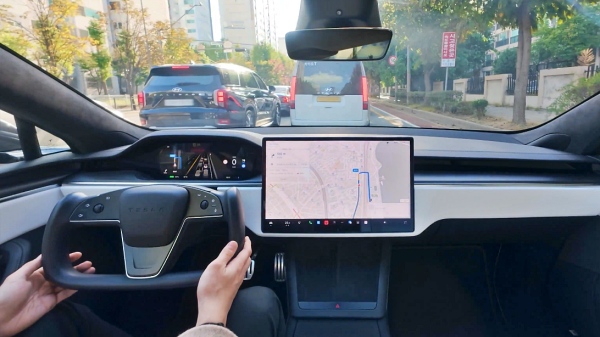
[Digital Today reporter Jinju Hong (홍진주)] Tesla’s latest driver-assistance system, Full Self-Driving (FSD) v14, shows noticeable performance gains, but critics say it could create new safety risks by lowering drivers’ vigilance. The analysis is that excessive trust in automation is emerging as a bigger problem than the system’s technical limits.
On June 1 (local time), electric vehicle publication Electrek reported that FSD v14 shows stable driving ability even in complex urban environments. But concerns are being raised that drivers’ attention could weaken as situations that do not require intervention for long periods are repeated.
FSD currently corresponds to a Level 2 advanced driver-assistance system (ADAS) under Society of Automotive Engineers (SAE) standards. Even if the system supports steering and acceleration and braking, the driver must always monitor road conditions and be ready to intervene immediately.
But some drivers who used FSD v14 for an extended period said it has become harder to stay tense as cases increased in which intervention was not needed for hundreds of miles.
Electrek assessed that the issue occurs not because FSD performs poorly but because it works too well. The more the system handles most situations without problems, the explanation goes, the more drivers become accustomed to merely monitoring the vehicle, and their reaction speed can slow when sudden intervention is needed.
According to early data, FSD v14 is said to have reached a level at which it can drive thousands of miles before a critical intervention is required. Converted into time, that means drivers could remain in a situation of simply monitoring the system for more than 30 to 40 hours.
The problem is that humans are not designed to suit this environment. In the field of automation systems research, this is explained as a “vigilance decrement” phenomenon. It refers to a sharp drop in concentration when people perform monitoring tasks for a long time without any special events. Studies have found that when a driver takes over manual control again in a situation where an automated system performs most tasks, an average of about 5 to 8 seconds of refocusing time is needed.
There are real cases as well. Rafi Krikorian (라피 크리코리안), who served as head of Uber’s self-driving unit, experienced an accident while using FSD in the past, and the vehicle was written off. Electrek said that even experts with a high understanding of self-driving technology can become accustomed to a system that operates normally for a long period and fail to respond properly in an emergency.
Similar warnings are also coming from regulators and the industry. The Insurance Institute for Highway Safety (IIHS) warned that automakers need to fully review Level 2 system design. The National Highway Traffic Safety Administration (NHTSA) is also strengthening oversight, including expanding accident reporting obligations related to Level 2 advanced driver-assistance systems.
More recently, comments by former Tesla insiders have also become controversial. According to what Reuters confirmed, 7 of 9 people who previously participated in a Tesla AI training project were reported to have said they would not entrust their driving entirely to FSD.
Tesla’s marketing approach has also come under scrutiny. Tesla has described FSD through its official X (formerly Twitter) account as a “personal chauffeur” or a “technology that gives freedom back.” Chief Executive Elon Musk has also claimed that FSD greatly improves quality of life and safety while driving.
But Tesla’s official terms still require continuous driver supervision and immediate intervention. The industry says there is a gap between promotional messages and the actual scope of responsibility for the system.
Criticism has also been raised in particular over Tesla introducing cases involving elderly drivers experiencing declining vision or users with physical disabilities as examples of FSD use. That is because Level 2 systems are premised on the driver being able to take back control of the vehicle at any time.
Experts say the key task for FSD going forward may not be simple performance improvements. They say a more important issue could be how to reduce the gap between the system’s actual functional level and the capability as perceived by drivers as the system advances.
The industry says a key point of future controversy will be whether Tesla further strengthens driver monitoring features and adjusts marketing expressions that could cause people to mistake FSD for full self-driving.
 Jinju Hong
hongjj@d-today.co.kr
Jinju Hong
hongjj@d-today.co.kr