
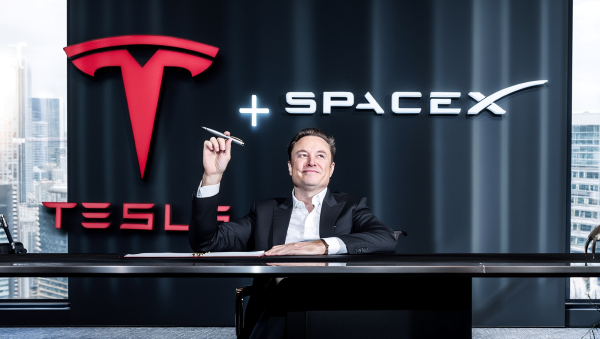
Criticism has been raised that if Tesla and SpaceX merge, Elon Musk (일론 머스크) could automatically trigger a massive compensation package without achieving operating performance targets.
On May 31, electric-vehicle outlet Electrek reported that a “change of control” clause in Tesla’s compensation contract is designed to apply only a market-capitalisation standard in a merger or acquisition, excluding operating performance targets.
The core of the controversy lies in the structure of Musk’s pay package that Tesla shareholders approved late last year. The package consists of 12 tranches. Each tranche is designed to require meeting business operating targets along with an increase in market capitalisation. Tesla officially calls it the “2025 performance-based stock contract.”
On the surface, the structure does not pay out compensation based only on a rise in the stock price. It requires tangible business performance backing, including vehicle sales, full self-driving (FSD) subscriptions, the robot business, commercial robotaxis and long-term profitability.
However, the main point of the criticism is that the change-of-control clause could produce a different outcome. The clause says that if a merger or sale occurs, “operating performance targets are ignored.” In that case, market capitalisation would be the only remaining criterion for deciding payouts.
At the current share price level, not all 12 tranches are met. But if a share price rise driven by merger expectations is added, the size of the payout could grow further, the report said.
An analysis has also been raised that this structure could become reality if SpaceX completes an initial public offering and then merges with Tesla through a share exchange. Musk bought Twitter in 2022 for $44 billion, or about 66.33 trillion won, and in 2025 he made a deal valuing it at $45 billion, or about 67.84 trillion won, through xAI.
Experts pointed to this as a pattern in which Musk has repeatedly carried out transactions among companies he controls while maintaining high corporate valuations.
SpaceX’s listing timetable is also cited as a variable. Under a change in Nasdaq rules, SpaceX can be included in an index in 10 days after an IPO, rather than after 1 year. In that case, large funds could flow in as Nasdaq- or S&P 500-tracking money adds SpaceX shares.
Critics also said that if a merger is pursued later through an all-share exchange with Tesla based on a high valuation, the two companies’ valuations could be inflated further together.
In that process, the biggest burden could fall on existing shareholders. Because stock compensation involves issuing new shares, Musk’s stake increases while existing shareholders’ ownership is diluted.
As a result, criticism has been raised that the contract clause excluding operating performance targets conflicts with the description of a performance-linked payout. The name of the package is the 2025 performance-based stock contract, making the structure’s potential to pay out even without achieving actual business results a central point of the controversy.
The controversy surrounding Musk’s pay package is expanding beyond the sheer size of compensation to issues of contract structure and money flows. If a SpaceX listing and index inclusion combine with the possibility of a merger with Tesla, key issues are whether the payout would be triggered based only on market capitalisation and how much shareholder dilution would occur in the process.
 Seung-a Yoo
ysah@d-today.co.kr
Seung-a Yoo
ysah@d-today.co.kr