
South Korea's Ministry of Science and ICT and the Korea Information Society Development Institute (KISDI) said on May 28 they had prepared a draft of artificial intelligence (AI) ethics principles and would begin collecting public feedback from May 29.
The draft carries forward the 2020 government-wide "AI Ethics Standards" while reflecting implementation of the AI Basic Act and recent changes in AI technology and the social environment, re-establishing it as national-level ethics principles. It is significant in that it sets out an overarching frame of reference to address concerns that relationships among individually accumulated guidelines by ministries, agencies and sectors have become unclear and could cause confusion in application.
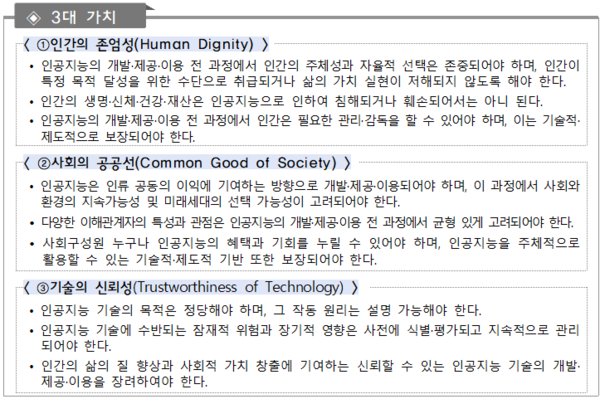
The draft consists of three core values and six principles. The three values are human dignity, the common good of society, and the trustworthiness of technology. The six principles to realize them are human autonomy, privacy, fairness and inclusiveness, sustainability, safety, and transparency.
Human dignity means that human agency and autonomous choice should be respected throughout the entire process of AI development and use, and that humans should not be treated as a means. The common good of society is the principle that AI benefits should not be concentrated on specific individuals or groups and should contribute to the public interest and sustainability of society as a whole. The trustworthiness of technology sets out a direction that risks and long-term impacts accompanying AI should be identified and assessed in advance and managed continuously.
MSIT and KISDI operated an advisory group of experts by field, including AI technology, law, institutions and philosophy, from December last year to April this year to prepare the draft. The advisory group consisted of an advisory committee of 9 members to discuss the direction for establishing the ethics principles and key issues, and a working group of 8 members responsible for drafting. It went through 7 plenary and working-group meetings, written reviews and other steps. It also separately collected opinions from industry to increase applicability in the field.
The feedback collection runs through July 8 on the website of the "AI Ethics Communication Channel". Participants include industry, civil society, relevant ministries, and academia.
Ryu Je-myeong (류제명), second vice minister of MSIT, said, "Leadership in the era of artificial intelligence depends not only on technological capabilities but also on how transparently and safely the technology can be managed," and added, "We will complete the final draft through broad and substantive collection of opinions."
 Seulgi Son
sageson@d-today.co.kr
Seulgi Son
sageson@d-today.co.kr