
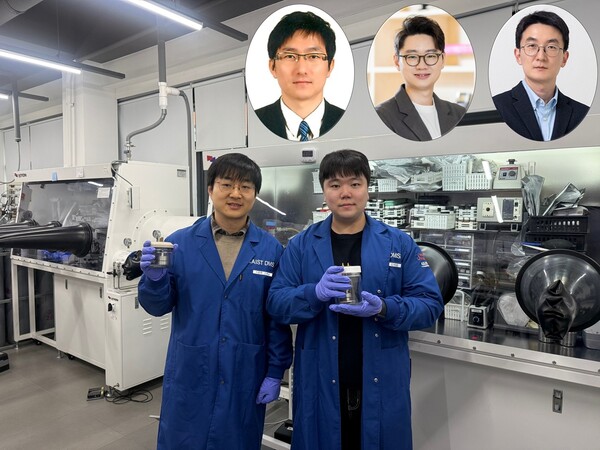
KAIST said on Jan. 7 that a research team led by professor Donghwa Seo of the Department of Materials Science and Engineering developed a design method that improves solid-state battery performance by 2 to 4 times using low-cost raw materials.
Solid-state batteries use solid electrolytes instead of liquid electrolytes, reducing the risk of fires and explosions. But making lithium ions move quickly through solids has required expensive metals or complex manufacturing processes. The team focused on divalent anions such as oxygen (O2-) and sulfur (S2-). Divalent anions enter the basic framework of an electrolyte’s internal structure and change its crystal structure.
The team developed a technology to control internal structures by introducing divalent anions into low-cost zirconium (Zr)-based halide solid electrolytes. The design principle is a framework-tuning mechanism. It widens the pathways for lithium-ion movement inside the electrolyte and lowers barriers during migration.
The team used precision analysis techniques including ultra-high-resolution X-ray scattering, pair distribution function (PDF) analysis, X-ray absorption spectroscopy (XAS), and computer-based electronic structure and diffusion modeling (DFT). It explained that electrolytes with oxygen or sulfur improved lithium-ion transport performance by at least 2 to 4 times compared with existing zirconium-based electrolytes. It achieved performance at a level that can be applied to actual solid-state batteries while using low-cost materials.
Room-temperature ionic conductivity measured about 1.78 mS/cm for electrolytes with oxygen (O2-) and about 1.01 mS/cm for electrolytes with sulfur (S2-). Ionic conductivity indicates how quickly and smoothly lithium ions move within an electrolyte, and higher values mean better battery performance. For example, 1 mS/cm or higher is assessed as sufficient for application in real batteries at room temperature.
Donghwa Seo said, "Through this study, we presented a design principle that can simultaneously improve cost and performance issues of solid-state batteries even with low-cost raw materials," adding, "The potential for industrial use is very large." First author Jaeseung Kim said the study goes beyond the question of what material to use in developing solid-state battery materials and presents direction on how to design them.
A KAIST official said, "We expect it will be applied to a broader range of solid electrolyte compositions in the future, greatly expanding the scope of industrial use."
The study lists KAIST researcher Jaeseung Kim and Dongguk University researcher Daseul Han as co-first authors. It was conducted in collaboration with teams led by professor Seonggyun Jeong at Seoul National University, professor Yunseok Jung at Yonsei University and professor Kyungwan Nam at Dongguk University. It was published in the international journal Nature Communications on Nov. 27, 2025. It was carried out with support from the Samsung Electronics Future Technology Incubation Center, the Korea Research Foundation and the National Supercomputing Center.
 Daegeon Seok
d2dg@d-today.co.kr
Daegeon Seok
d2dg@d-today.co.kr