
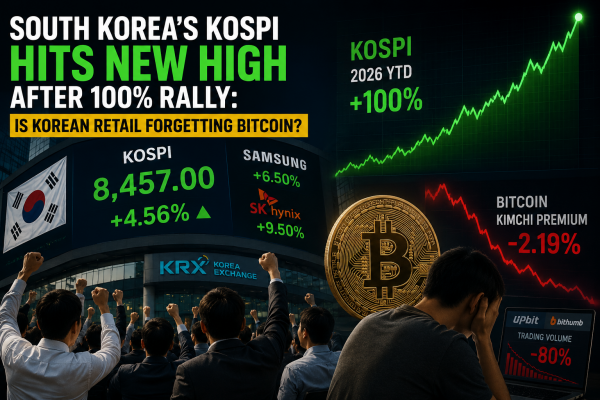
The KOSPI broke above 8,400 for the first time and has risen 100 percent so far in 2026. Semiconductor shares led the rally, and a shift of domestic investor money from the cryptocurrency market to equities is becoming more apparent.
On May 27, the KOSPI jumped 4.56 percent in a single day. Market capitalisation increased by about 300 trillion won in one day to above 6,400 trillion won. Samsung Electronics and SK Hynix were at the center of the rise. Samsung Electronics gained 6.5 percent and SK Hynix rose 9.5 percent, and their combined share of KOSPI market value was estimated at about 42 percent.
The market views rising demand for memory semiconductors driven by the spread of artificial intelligence as a key factor behind the rally. Overseas market analysts are also taking a close look. According to foreign media including Cointelegraph, market commentator Heisenberg said, "All memory-related assets are currently rising vertically." JPMorgan also recently raised its KOSPI target to 9,000 from its previous level, and cited the possibility of 10,000 under a bullish scenario.
The concentration of retail investor funds is also strengthening. A two-times leveraged SK Hynix ETF listed in Hong Kong has attracted about $1.3 billion since the start of the year, and its assets under management expanded to $8 billion in just 3 months. It is assessed as the world's largest single-stock leveraged ETF. A two-times leveraged Samsung Electronics ETF has also shown a similar trend and was reported to have surpassed the size of leveraged products tied to Tesla and Microsoft. The Kobeissi Letter noted that Asian retail investors are making more aggressive leveraged bets on semiconductor shares than ever.
By contrast, South Korea's cryptocurrency market is relatively subdued. Upbit and Bithumb account for most of South Korea's cryptocurrency trading volume, but domestic crypto trading value has fallen by about 80 percent as recent won liquidity moved to the stock market centered on semiconductor shares. The kimchi premium, which reflects domestic demand for bitcoin, also fell to about minus 2.19 percent.
There is also a precedent for funds returning to the cryptocurrency market when the stock market wobbles. The KOSPI fell 8.4 percent in a day after breaking above 8,000 intraday on May 15, and about $370 billion in market capitalisation disappeared at the time. Domestic cryptocurrency trading volume also rebounded temporarily during the move.
Policy variables also remain. President Lee Jae-myung (이재명) has pledged to introduce a won-pegged stablecoin and pursue a spot bitcoin ETF. Under the current framework of the Digital Asset Basic Act, a consortium of eight banks including KB Kookmin Bank, Shinhan Bank and Woori Bank is preparing a regulated won stablecoin.
Behind the move is concern over capital outflows. South Korean cryptocurrency exchanges remitted about $40 billion overseas in the first quarter of this year, and stablecoins accounted for half of that, it was reported. The government and the financial sector see the introduction of a won-based stablecoin as a way to keep some liquidity in the domestic market.
The key point to watch is the direction of money flows rather than further gains in the KOSPI. As the KOSPI has risen 100 percent in 5 months on a borrowing-backed rally, some cite the possibility that retail money could move back into bitcoin and the domestic altcoin market if volatility increases. In particular, with South Korea's cryptocurrency investors estimated at about 10 million people, more than 30 percent of the total population, analysis says shifts in funds between equities and cryptocurrencies could determine future market volatility.
 Jinju Hong
hongjj@d-today.co.kr
Jinju Hong
hongjj@d-today.co.kr