
South Korea’s Ministry of Science and ICT and the Ministry of Food and Drug Safety held a demonstration on May 27 of an "artificial intelligence (AI) imported food inspection solution" at OSCO in Heungdeok-gu, Cheongju, North Chungcheong Province.
The solution was developed as part of an MSIT-led "public AX project". The public AX project is a programme that applies AI to the public sector based on ministry demand to innovate public services and improve administrative efficiency.
MSIT selected a project titled "Development and demonstration of an AI imported food inspection solution to ensure safe dining tables for the public" through a 2025 call for proposals. MSIT and MFDS are pursuing the development of AI services to respond to the risk of hazardous foods that do not meet domestic standards entering the country and to strengthen public safety.
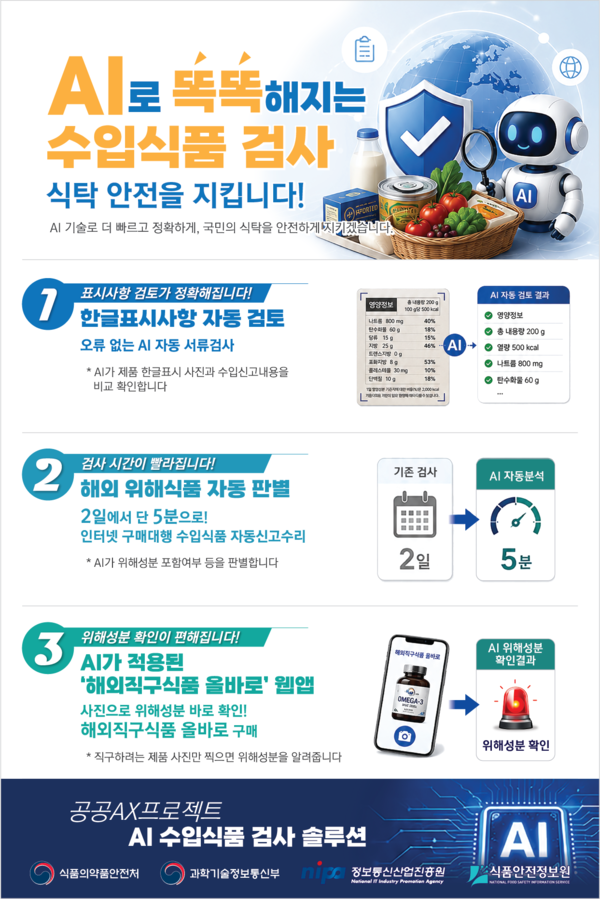
The AI imported food inspection solution uses AI to automatically review imported food labelling information and quickly determine whether a product is a hazardous food from overseas. The solution is set to be installed on the "Import Safety Electronic Review 24" integrated electronic screening platform for imported foods.
At the demonstration, officials introduced key functions of 3 AI-based imported food safety management systems: an automatic review system for Korean labelling on imported foods, a hazard determination system for imported foods purchased via online purchasing agents, and the Olbaro web app for foods bought through direct overseas online shopping.
The automatic review system for Korean labelling analyses Korean labelling on imported foods using AI and checks whether it complies with labelling standards. The hazard determination system for online purchasing-agent imported foods automatically accesses product websites and determines whether blocked ingredients are indicated. The Olbaro web app checks whether a product is subject to import blockage and whether it contains hazardous ingredients when consumers upload a photo of the product.
The project will run through December. The budget totals 2.55 billion won, and InfoValley Korea and ATOZ will carry out the work. MSIT and MFDS plan to reflect suggestions from the field in system improvements.
Hong Sung-wan (홍성완), MSIT director general for information and communications policy, said he hoped the project would contribute to ensuring safety in people's daily lives together with MFDS. He said MSIT would continue to work with related ministries to rapidly expand AI services that the public can feel.
Han Un-seop (한운섭), MFDS director general for imported food safety policy, said the AI imported food inspection solution is an innovative technology that helps the public safely consume imported foods. He said MFDS would thoroughly check the solution and do its best to ensure it can be applied in the field within this year.
 Jin-ho Lee
jhlee26@d-today.co.kr
Jin-ho Lee
jhlee26@d-today.co.kr