
A public-participation growth fund is expected to emerge as a channel for supplying venture capital to unlisted companies and Kosdaq firms listed under a technology-special listing track. Its investment focus is on growth companies in advanced strategic industries rather than large listed stocks.
Political and financial investment industry sources said on Wednesday that the Financial Services Commission will sell the public-participation growth fund to the general public for three weeks from May 22 to June 11. The sale size is 600 billion won. It will be sold on a first-come, first-served basis online and offline through 10 banks and 15 securities firms, and could close early if the allocation runs out.
The fund will be set up at 720 billion won by combining 600 billion won from the public and 120 billion won in fiscal funding intended to take losses first. Under the investment structure, public money is pooled into a master fund, which then invests across 10 feeder funds.
Feeder fund managers include DS Asset Management, Mirae Asset Management, Life Asset Management, Midas Asset Management, Timefolio Asset Management, Korea Investment Value Asset Management, The J Asset Management, Suseong Asset Management, Orion Asset Management and KB Asset Management.
The key issue is where the money flows. Each feeder fund must invest at least 60 percent of its committed capital in companies in advanced strategic industries and related firms.
The target industries are 12 areas: semiconductors, secondary batteries, vaccines, displays, hydrogen, future vehicles, biotech, artificial intelligence, defence, robots, content and critical minerals.
In particular, at least 30 percent of each feeder fund's committed capital will be invested as new funding in unlisted companies and Kosdaq firms listed under the technology-special listing track. Each of those categories must receive at least 10 percent.
The main investment methods are those that put money directly into companies, such as paid-in capital increases and mezzanine financing. The approach is more geared toward supporting fundraising by companies in the growth stage than secondary investments that trade existing stakes.
The KOSPI investment share is capped. Stock market investments recognised as core-purpose investments are limited to within 10 percent. This shows the public growth fund is not a public offering fund that simply invests in large listed stocks, but a product aimed at supplying scale-up funding to unlisted innovative companies and technology-special Kosdaq firms.
The FSC explained that these investment guidelines are intended to ease the so-called "valley of death" problem promising advanced-technology companies face during their growth process. It aims to supply new funding to companies that have technology but lack money for large-scale facilities investment, research and development, and business expansion.
Some feeder funds will also participate in the form of Kosdaq venture funds. Timefolio Asset Management, The J Asset Management and Suseong Asset Management plan to participate as Kosdaq venture funds that receive preferential allocations in initial public offerings. As a result, the fund must meet both the public-participation growth fund requirements and the Kosdaq venture fund requirements.
For investors, key features include tax benefits and a loss-buffer mechanism. Subscribing through a dedicated account allows income deductions of up to 18 million won depending on the investment amount.
A deduction rate of 40 percent applies to amounts up to 30 million won, 20 percent to the portion over 30 million won and up to 50 million won, and 10 percent to the portion over 50 million won and up to 70 million won. Dividend income will be taxed separately at 9 percent for five years from the investment date.
Eligible subscribers are those aged 19 or older, or workers aged 15 or older. The investment limit for the dedicated account is 200 million won over five years, and the fund subscription limit is 100 million won per person per year. If subscribing through a general account without tax benefits, the investment limit is 30 million won per person per year.
Of the total sales amount, 120 billion won, or 20 percent, will be allocated as a tranche reserved for working-class investors with earned income of 50 million won or less or comprehensive income of 38 million won or less.
Fiscal funding will participate in each feeder fund as a subordinated investor and take losses first within a 20 percent range. This does not mean the product guarantees principal.
The public-participation growth fund is a financial investment product that can result in principal loss. The structure has the government taking part of the loss first, but investor losses can occur depending on feeder fund performance and market conditions.
Recent cash flows around the stock market are favourable to the policy push. Meritz Securities said average daily domestic trading value was 68 trillion won in April and averaged 109 trillion won on May 4 and May 6. Client deposits also rose 13.1 percent from the previous month to 124.8 trillion won in April.
As funds continue to move into the domestic stock market, measures are also being prepared to broaden the investment scope to include unlisted companies, such as the public-participation growth fund and business development companies, or BDCs.
Still, the public-participation growth fund could have greater volatility in its investment targets than general public offering funds. Unlisted companies and technology-special Kosdaq firms have strong growth potential, but uncertainty is also significant in terms of earnings visibility, liquidity and valuation.
Investors should consider that funds could be tied up for five years and the venture-capital nature of the investment, rather than approaching it based only on tax benefits and the loss-first structure.
The market sees the public-participation growth fund as likely to have a more direct impact on Kosdaq and unlisted growth companies than on large KOSPI stocks.
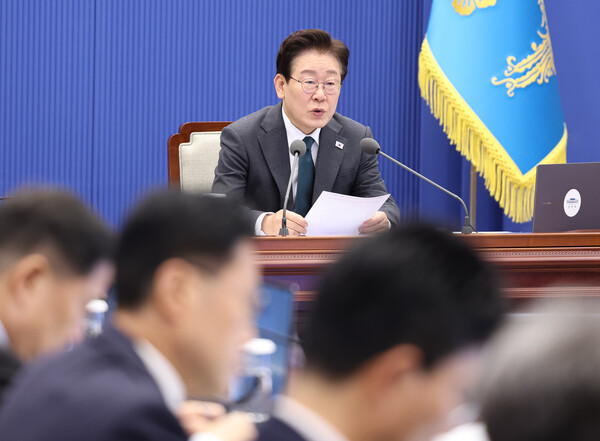
President Lee Jae-myung (이재명) said at the meeting with senior secretaries and aides that day, "Creating the public growth fund will help spread productive finance and serve as a priming water that contributes to the development of future advanced industries and the stable growth of people's assets."
The government is aiming to promote both advanced-industry development and household asset formation through the fund. An analysis says that because policy funding is designed to be supplied as new funding, it could help improve the fundraising environment for companies that need additional growth capital after a technology-special listing or for advanced-industry firms ahead of listing.
Cho Ah-hae (조아해), an analyst at Meritz Securities, said, "With the launch of the public-participation public growth fund and the introduction of business development companies (BDCs), an environment is being created in which it is possible to invest even in unlisted companies." She added, "Policies to improve access to the stock market, such as the launch of leverage ETFs for high-quality domestic stocks and the easing of regulations on integrated accounts for foreigners, are also being implemented, so a favourable environment is continuing."
 Oh Sang-youp
yub@d-today.co.kr
Oh Sang-youp
yub@d-today.co.kr