
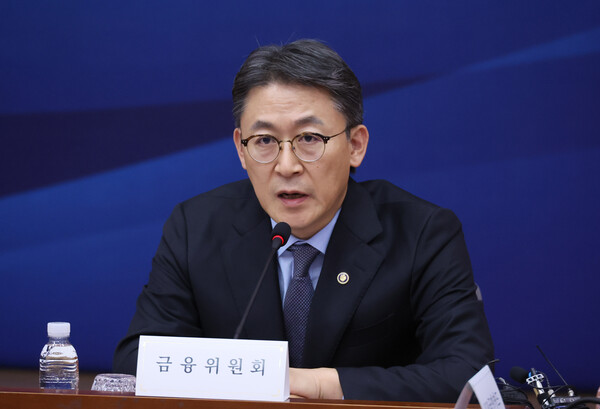
South Korea's Financial Services Commission held a consultative body meeting with comprehensive investment finance companies, SME-focused securities firms and policy financial institutions to discuss improvements to rules and measures to revitalise exit markets, aimed at boosting the financial investment sector's capacity to supply risk capital.
The FSC said it held the meeting, chaired by Vice Chairman Kwon Dae-young (권대영), at the Korea Financial Investment Association in Seoul's Yeouido district on Wednesday.
The meeting discussed comprehensive investment firms' risk-capital supply performance in the first quarter of 2026, measures to improve the SME-focused securities firm system, the status of building a risk-capital intermediation platform, ways for the financial investment industry to jointly support exit markets, and the status of leverage investment and responses.
According to the FSC, seven comprehensive investment firms with risk-capital supply obligations provided a total of 99 trillion won in risk capital in the first quarter. That was an increase of 20 trillion won from the fourth quarter of last year.
The average ratio of risk-capital supply to funds raised through short-term notes and integrated investment management accounts stood at 17.3 percent, above this year's required ratio of 10 percent. All seven firms exceeded the regulatory ratio.
By investment target, the largest amount went to mid-sized companies at 45 trillion won. It was followed by primary collateralised bond obligations (P-CBO) at 23 trillion won, small and venture companies at 21 trillion won, debt securities rated A or below at 14 trillion won, and new technology venture capital companies at 13 trillion won.
By investment method, debt securities accounted for the largest share at 71 trillion won, followed by equity securities at 31 trillion won, hybrid securities such as redeemable convertible preferred shares (RCPS) and convertible bonds (CB) at 20 trillion won, and loan receivables at 13 trillion won.
The FSC is also pushing to improve the SME-focused securities firm system. It will change the current approach of designating around eight securities firms every two years by extending the designation period to three years and expanding the number of designated firms to around 10. The plan is to increase incentives to supply mid- to long-term funding to small and venture companies.
Incentives will also be strengthened. Korea Securities Finance will extend the maturity of securities-backed loans from a current maximum of one year to a maximum of three years, and introduce preferential terms for interest rates and maturities for term repurchase agreements (RP).
Korea Development Bank and Korea Growth Investment will create a new fund dedicated to SME-focused securities firms in 2027. They plan to expand bonus points by more than 50 percent for SME-focused securities firms when selecting fund managers.
Industrial Bank of Korea will expand investments in funds created by SME-focused securities firms to at least 100 billion won during the sixth round.
Evaluation criteria will also be adjusted. The preferential selection of the top four firms in quantitative evaluations, previously limited to existing SME-focused securities firms, will be expanded to all applicants. The evaluation weighting will be changed from 30 percent quantitative and 70 percent qualitative to 50 percent quantitative and 50 percent qualitative.
The FSC plans to designate the sixth round of SME-focused securities firms in June this year. It plans to apply the revised operating guidelines and evaluation criteria starting with the sixth-round designation.
It is also pushing to build a risk-capital intermediation platform. It is market infrastructure that supports search, recommendations and matching by aggregating information on innovative companies that need funding and institutional investors such as securities firms and venture capital companies that supply funds. Financial regulators are building it with a goal of launching in July, and the Financial Supervisory Service is supporting consulting.
Ways for the financial investment industry to jointly invest to revitalise exit markets were also discussed. The FSC said South Korea's venture and startup ecosystem relies excessively on initial public offerings, and that exit routes such as mergers and acquisitions and secondary deals need to be diversified.
The financial investment industry and others are reviewing a plan to pursue secondary investments worth about 1 trillion to 2 trillion won. They plan to draw up detailed operating measures by June.
Risk management for leverage investment was also a key agenda item. Market concerns have been raised as the size of leverage investments such as margin loans has increased recently.
Some assessments say the relative size compared with the stock market and investor deposits is lower than the historical average and remains manageable. Others have pointed out that excessive leverage, short-term speculation and concentration in theme stocks could become risk factors as stock market volatility rises.
Securities firms are currently implementing their own risk management measures, such as daily trend checks, restrictions on new margin loan handling, and transaction limit controls by stock and by counterparty.
Financial authorities plan to have each securities firm re-examine leverage investment trends and the state of risk management under the supervision of its chief executive officer, and review additional measures if necessary.
Kwon said that although the securities industry has posted record results in recent years, it is time to coolly look back on whether such profits are based on the industry's insight and capabilities or driven by the external environment.
"Selecting growth potential hidden behind risk and creating new added value is the reason the securities industry exists and the first step toward productive finance," Kwon said.
"Replicating business models is a shortcut to a zero-sum game," he added. "We must focus on building differentiated investment capabilities and irreplaceable expertise through insightful research and sophisticated screening."
On risk management, he said it "must become an ongoing strategy, not post-event damage control." He added that the stronger the market, the more each company should stay highly alert and strictly manage leverage investment.
He also said trust, which underpins the securities industry, has been shaken by recent cases including mis-selling of financial products and the contracts for difference (CFD) incident, and called for a customer-centred sales structure and internal control systems.
 Oh Sang-yup
yub@d-today.co.kr
Oh Sang-yup
yub@d-today.co.kr