
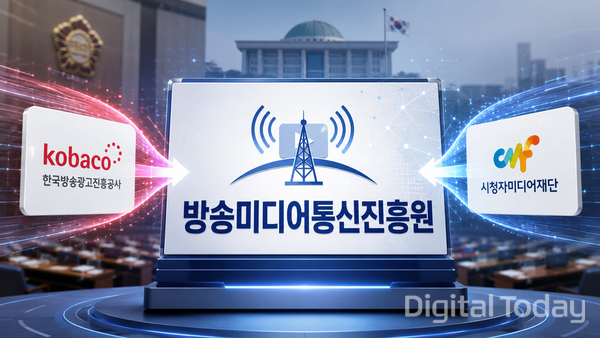
The National Assembly Science, ICT, Broadcasting and Communications Committee approved an amendment to the Framework Act on Broadcasting and Communications Development to establish the Korea Broadcast Media Telecom Promotion Agency. It would be an agency under a broadcast media telecom commission dedicated to promoting broadcast media. Issues remain before passage by the plenary session, including fairness in job succession, differences in business areas, objections from related ministries and opposition party resistance.
At a full committee meeting on Wednesday, committee chair Choi Min-hee (최민희) of the Democratic Party said agenda item 36, the amendment bill, would not be referred to the plenary session. She said it would instead be proposed as agenda item 37, a committee alternative as suggested by the legislation review subcommittee, and declared it approved.
The bill, sponsored by Democratic Party lawmaker Kim Hyun (김현), calls for merging the Korea Broadcast Advertising Corp (Kobaco) and the Viewer Media Foundation to establish the new agency. The two organisations will be dissolved at the time of the agency’s launch. Its expected scale is a budget of 139.9 billion won and a staffing level of about 900. The effective date is Jan. 1, 2027.
The new agency will take charge of 34 projects, including promotion of broadcast media, protection of viewers’ and users’ rights and interests, and revitalisation of the broadcast advertising industry. Its work would cover broadcast advertising sales representation, support for disaster broadcasting, inter-Korean cooperation, prevention of distribution of illegal and harmful information, and operation of a transparency centre.
According to the bill’s addendum, some projects from seven organisations under the Ministry of Science and ICT will be transferred to the new agency. They are the Korea Communications Agency (KCA), Korea Internet and Security Agency (KISA), National Information Society Agency (NIA), Korea Information Society Development Institute (KISDI), Korea Association for ICT Promotion (KAIT), Radio Promotion Association of Korea (RAPA) and Telecommunications Technology Association (TTA). Some projects from private associations and groups, including the Korea Virtual Convergence Digital Industry Association, the Broadcasting and Communications User Protection Association and the Korea Telecommunications Operators Association, will also be moved.
Kim said on Wednesday that when the Korea Communications Commission and the Ministry of Science, ICT and Future Planning were split in 2013, most related public institutions were placed under the science ministry, creating confusion in the commission’s command and oversight system. He said the integration would make it possible to carry out roles in broadcasting, media and telecommunications that had been scattered. Kim added it was not rushed but had been stalled for the past three years, and said it created a foundation to properly pursue projects that had not met needs, including strengthening access to broadcasting for marginalised groups and supporting one-person media.
The opposition party made its opposition clear. People Power Party members of the committee did not take part in the vote, saying there had been insufficient social discussion. Choi Hyung-du, the People Power Party’s committee floor leader, criticised the move, saying there was not enough explanation and social discussion on how to organise the agency’s functions and roles and its relationship with existing organisations. He said a reorganisation of broadcasting and communications governance was not a simple matter of reshuffling organisations but a major issue that directly affects the direction of national media policy, the regulatory system and institutional independence. After the remarks, People Power Party members left the meeting.
The issue of job succession is also a point of contention. The average annual salary for permanent employees at Kobaco is 88.9 million won, compared with 56.83 million won at the Viewer Media Foundation and 36.7 million won at Kobaco Partners, a Kobaco unit, highlighting large differences in treatment among the organisations. Treatment for Kobaco Partners is not specified in the original bill and has been left to the discretion of the founding committee. People Power Party lawmaker Kim Jang-gyeom (김장겸), a member of the committee, said he was concerned about a “second Incheon International Airport incident,” referring to the 2020 case under the Moon Jae-in government in which airport security screeners were converted into regular employees of the airport operator.
Differences in business areas have also come under scrutiny. The projects to be brought under one roof range from broadcast advertising sales representation to disaster broadcasting and inter-Korean cooperation. There are differing views even within the ruling party. Democratic Party lawmaker Lee Hoon-ki (이훈기) said Kobaco and the Viewer Media Foundation are substantially different organisations and questioned whether the merger would have synergy effects.
Pushback from related ministries is also an obstacle. The Ministry of Culture, Sports and Tourism said it opposes including “media” in the organisation’s name. It cited concerns about overlapping responsibilities because the promotion of newspapers, magazines, publishing and advertising falls under the ministry’s purview. The Office for Government Policy Coordination said transferring KISDI’s research functions could conflict with the Act on the Management of Public Institutions. The Ministry of Science and ICT is taking a reserved stance.
Opposition is also strong among the organisations targeted for consolidation. The Viewer Media Foundation, KISA, NIA and KISDI have made their opposition clear. Private associations and groups including KAIT, TTA, the Broadcasting and Communications User Protection Association and the Korea Telecommunications Operators Association also expressed concerns, saying careful review is needed.
Fiscal soundness has also been cited as a problem. According to the public institutions management information disclosure system, Kobaco is in a state of partial capital impairment as of 2025, with total equity capital of 247.4 billion won below its paid-in capital of 300 billion won. The bill stipulates that the new agency will comprehensively succeed to Kobaco’s claims and debts, creating a structure in which it takes on weaknesses at launch.
Against this backdrop, the broadcast media telecom commission said it would actively support legislation needed to establish the new agency. At a news conference marking his first 100 days in office, commission chair Kim Jong-cheol (김종철) said he would actively support the legislative discussion process so that a rational and effective system is put in place after sufficiently gathering opinions from all sectors of society.
The bill will go to a plenary session after a review of legal structure and wording by the Legislation and Judiciary Committee. A view from inside and outside parliament says the Democratic Party will accelerate the process with the goal of handling it before the expiry of the first half of the 22nd National Assembly’s term on the 29th of this month. There is also an expectation it will clear the hurdle of a plenary session within this month.
A committee official said that for the Democratic Party, the period until Chair Choi’s term ends amounts to the last chance to pass the bill under the current committee structure. The official said floor leader Kim and others leading the bill are known to be persuading lawmakers’ offices by arguing the rationale of the Lee Jae-myung government’s stance on consolidating ministries and agencies.
 Son Seul-gi
sageson@d-today.co.kr
Son Seul-gi
sageson@d-today.co.kr