
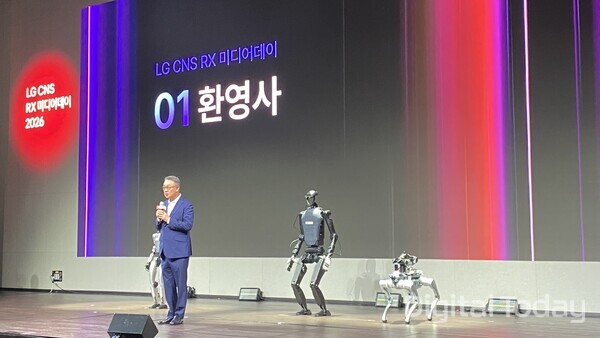
LG CNS unveiled its robot transformation (RX) platform brand, Physicalworks, integrating robot training and operations.
At an RX media day held on Wednesday at LG Sciencepark in Magok, Seoul, LG CNS CEO Shin Kyun-hyun (현신균) said, "We will integrate full-stack capabilities from robot training to deployment and operations to create a new standard for commercialising physical AI." He added, "Ultimately, we will implement a robot-centric autonomous operating system."
Physicalworks supports the full lifecycle, from robot data collection, training and validation to field deployment, operations and monitoring. This is the first time a South Korean company has launched an end-to-end platform under its own brand covering everything from robot training to operations.
LG CNS, as a systems integration company, highlighted expertise in logistics and manufacturing sites. Based on experience carrying out hundreds of automation projects, it positioned as its business core not robot hardware but a "system that makes robots work."
Lee Jun-ho (이준호), executive vice president of LG CNS' Smart Logistics City business division, said, "Conventional automation repeated predetermined actions, but now it must understand situations, judge and act." He added, "Who can secure higher-quality data faster will determine competitiveness in the robotics business." Lee described robots as "digital labour" and said integrated operations are increasingly needed, from work planning and assignment to real-time operations management, performance management and retraining.
Physicalworks consists of 2 platforms: Forge, dedicated to training, and Baton, for operations and monitoring.
Forge handles everything from collecting robot training data to validation and field deployment. It generates simulation data in a 3D virtual environment and uses it for training. It moves away from the existing approach in which humans repeatedly demonstrate actions thousands of times. The company plans to later add methods that convert videos of human work into training data or use motion capture.
It also automated data selection. AI automatically selects, organises and processes data that is valid for robot training. After training, robots undergo simulation validation in a 3D virtual environment before being deployed in the field. The company said this can reduce the time to field deployment from several months to 1 to 2 months. It is currently conducting robot proof-of-concept projects with more than 20 customers in electronics, chemicals, logistics and shipbuilding.
Park Sang-yeop (박상엽), LG CNS chief technology officer, said, "For a dancing robot to work in the field, it takes more than 120 technologies, more than 50 experts and more than 10,000 hours." He added, "We can solve this fastest and at minimal cost with the Physicalworks platform."
Baton integrates monitoring of robots with different forms and manufacturers, including bipedal, quadrupedal and wheeled types, in a single system. It addressed the issue of different control methods and operating screens by standardising and systematising them. It also automated responses to unexpected situations. If a conveyor belt stops, it automatically reconfigures logistics routes, and if a specific robot stops, it immediately switches the task to another robot.
LG CNS said that, based on an operating environment of 100 autonomous mobile robots (AMR) and automated guided vehicles (AGV), it can improve productivity by at least 15 percent and cut operating costs by up to 18 percent. Baton is currently being applied to integrated monitoring of 4 types of robots - patrol, barista, luggage-carrying and cleaning - in the Busan Smart City national pilot city project.
◆ Demonstration of autonomous collaboration by 4 types of heterogeneous robots
A demonstration also showed 4 types of heterogeneous robots - bipedal, quadrupedal, wheeled and AMR - autonomously collaborating at a logistics site without human remote control. Robots that completed training through Forge divided tasks based on Baton and moved in coordination. LG CNS stressed this was the first public demonstration in South Korea of heterogeneous robots autonomously collaborating without remote control.
Son Dong-shin (손동신), a member of the Future Robotics Lab, said, "Most companies show robot action demonstrations through remote control (teleoperation), but today is a scene where robots work with 100 percent self-judgment through training of a robot foundation model (RFM)."
LG CNS named this a "dynamic factory" that goes beyond a fully automated factory, or "dark factory." It refers to a factory where production lines can be switched in real time through software upgrades alone. Park said, "Not only mass production of small varieties through fixed production lines, but also small-lot production of many varieties will become possible without time delays." He added, "An era of robot swarm intelligence will come, where hundreds and thousands of robots move with one intelligence."
 Seulgi Son
sageson@d-today.co.kr
Seulgi Son
sageson@d-today.co.kr