
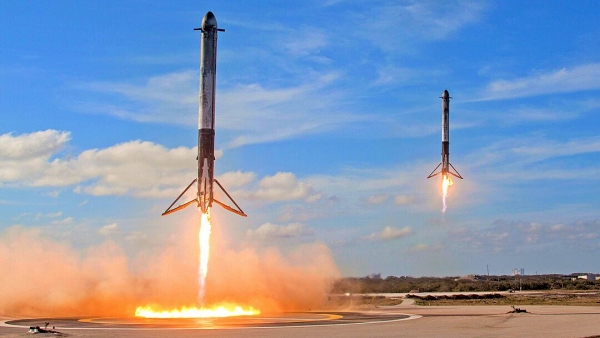
SpaceX is reducing the share of launches by its workhorse Falcon 9 rocket and reorganising its launch system around the next-generation heavy-lift Starship. An analysis says this is a strategic shift to increase Starship use for long-term businesses such as Moon and Mars exploration, next-generation Starlink and space data centres, rather than a Falcon 9 performance problem.
On May 6 local time, IT outlet Ars Technica reported that SpaceX has recently adjusted how it operates launch infrastructure in Florida and California, speeding up a transition to a Starship-centred structure.
Falcon 9 is not being retired immediately. But the rise in launches has eased. SpaceX carried out 165 Falcon 9 launches last year, its largest-ever record. That was a sharp increase from 134 combined Falcon 9 and Falcon Heavy launches in 2024 and 96 Falcon-family launches in 2023. Gwynne Shotwell (기네 쇼트웰), SpaceX president, said early this year that Falcon launches in 2026 would be about 140 to 145, and that Falcon launches would gradually decline once Starship enters full operation.
The change is most evident at Cape Canaveral, Florida. SpaceX has regularly launched Falcon 9 from two sites: LC-39A at NASA's Kennedy Space Center and SLC-40 at Cape Canaveral Space Force Station. LC-39A is now being converted into a dedicated Starship launch site. LC-39A will be excluded from routine Falcon 9 operations and, if needed, used on a limited basis for Falcon Heavy launches. SpaceX has recently resumed Falcon Heavy launches there for the first time in about 1.5 years.
Operations for offshore landing platforms are also being adjusted. SpaceX has ended operations for 1 of the 2 drone ships it had stationed in Florida. The vessel will be used to transport Starship and Super Heavy boosters built at its Texas factory to Florida.
SpaceX is also building a second Starship production facility at the Kennedy Space Center. It is also pursuing plans to begin Starship flights from Florida before the plant is completed.
By contrast, the centre of Starlink satellite launches is shifting to Vandenberg Space Force Base in California. SpaceX plans to conduct a large portion of Starlink launches from Vandenberg. There, it can operate at intervals of 3 to 4 days from the same launch pad. More than half of SpaceX launches this year have taken place at Vandenberg, up sharply from less than 40 percent last year. If the trend continues, some have raised the possibility that Vandenberg could become SpaceX's largest launch hub.
Still, Falcon 9's role itself is not disappearing. As the possibility grows that the International Space Station will operate at least through 2032, Falcon 9 and the Dragon spacecraft are expected to remain the key means of U.S. crewed space transport for the time being. The U.S. Space Force is also expected to rely heavily on Falcon 9 and Falcon Heavy into the 2030s.
Starship, by contrast, is expected to expand its role around large satellites and next-generation space infrastructure. SpaceX plans to prioritise Starship for launches of upgraded Starlink satellites, and later use it to build orbital data-centre nodes and for NASA Moon landing missions. Moon exploration missions in particular require repeated launches for in-space refuelling, making a mass-operation system for Starship a key factor.
The industry sees the change as less a cutback of Falcon 9 than a reshuffling of SpaceX's launch portfolio. Analysts say a two-track structure is taking shape, with Falcon 9 handling crew transport and national security missions, and Starship taking on ultra-large satellites and next-generation space infrastructure construction.
 Jinju Hong
hongjj@d-today.co.kr
Jinju Hong
hongjj@d-today.co.kr