
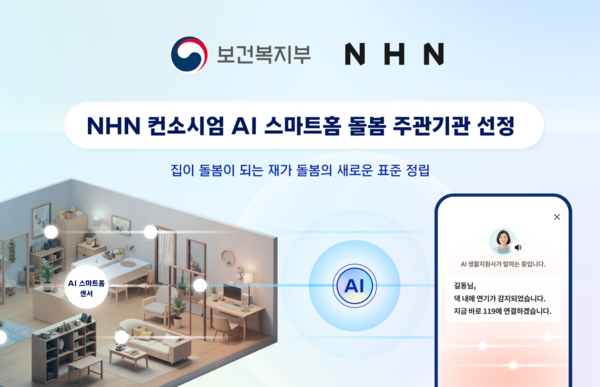
An NHN consortium has been selected as the lead organisation for the Ministry of Health and Welfare’s “support programme for rapid commercialisation of artificial intelligence (AI) application products” in the smart home field, NHN said on Wednesday.
The project aims to integrate AI and Internet of Things technologies into care services to provide 24-hour integrated safety, emotional and health services.
The consortium includes NHN and its senior-care unit NHN Waplat, along with 12 companies and institutions. They include SK Shieldus and Marknova (security, monitoring and device infrastructure), Hangang System (an app supporting care workers’ tasks), Kakao Healthcare, Healthmax, Mindhub and iClo (health and precision care), NHN Service, Kyung Hee University’s AgeTech Research Institute and the Korean Society for Artificial Intelligence (quality and academic verification), and Gyeonggi Province and South Jeolla Province (pilot cooperation).
NHN will build a smart home platform that collects, links and standardises diverse care data and uses AI for integrated analysis. It will support care workers and local governments to use the analysis results immediately in the field. It will also develop an in-house conversational AI engine enabling two-way communication between older people and AI.
Pilot tests will be conducted for a total of 400 households in Gyeonggi and South Jeolla provinces. The plan is to verify the system simultaneously in two regions, Gyeonggi as an urban area and South Jeolla with a high share of rural and fishing communities, to secure a broadly applicable AI care model. After the project ends, it plans to build an integration model with the Korea Social Security Information Service’s regional health and medical information system and to lay the groundwork for nationwide expansion by 2027.
Hwang Sun-young (황선영), head of NHN’s WA business unit, said, “We will establish a new standard for at-home care where the home itself becomes care, and expand it into a care system that works anywhere nationwide.”
Lee Sran (이스란), first vice minister of health and welfare, said, “This project is a starting point for fully integrating technologies and data such as AI and IoT into care.” She added, “We will implement care in which technology helps people and AI supports work.”
 Seulgi Son
sageson@d-today.co.kr
Seulgi Son
sageson@d-today.co.kr