
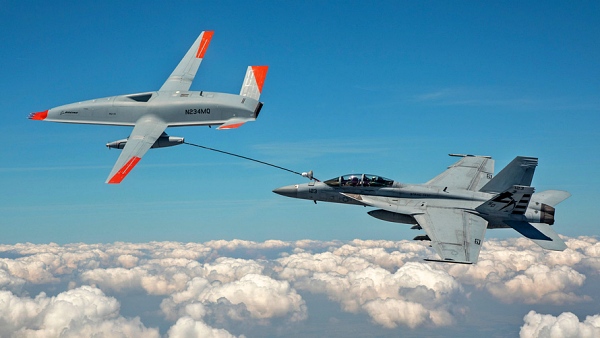
The U.S. Navy’s MQ-25A Stingray autonomous aerial refuelling drone has completed its first flight. TechRadar reported on Tuesday that the test lasted about 2 hours over southern Illinois.
The MQ-25A autonomously carried out taxi, takeoff, flight and landing under a pre-set mission plan. Commands were issued through the MD-5 ground control station, part of the unmanned carrier aviation mission control system. Pilots set the route and waypoints before departure, monitored aircraft performance during the flight and could halt or adjust the mission if needed.
After the mission began, the aircraft handled propulsion, guidance, subsystems and flight control on its own. The U.S. Navy plans to expand autonomous operations while keeping human oversight as it operates the MQ-25A.
Dan Gillian (댄 길리언), vice president and general manager for Boeing Air Dominance, said the flight was carried out based on experience accumulated from the MQ-25A T1 prototype. He assessed the test as an achievement that raised the programme’s maturity.
The MQ-25A is designed to take over the aerial refuelling role currently handled by the F/A-18 Super Hornet. That would allow the Super Hornet to be returned to strike and combat missions. Rear Admiral Tony Rossi (토니 로시), who leads the U.S. Navy’s unmanned aviation and strike weapons programme, explained that the MQ-25A is the first step in integrating unmanned aerial refuelling on aircraft carrier decks.
The MQ-25A T1 prototype previously flew about 125 hours to prove the concept and lay the groundwork for this test. The latest test also confirmed integration with the Rolls-Royce AE 3007N engine and the ground control system.
The MQ-25A will conduct additional test flights at MidAmerica St. Louis Airport. It will then move to Naval Air Station Patuxent River in Maryland to begin preparations for aircraft carrier qualification flights.
The first flight also reflects that the U.S. Navy’s plan to shift aerial refuelling missions to unmanned aircraft and reassign the roles of existing fighter jets has moved closer to the operational stage.
 Hyunwoo Choo
cookinpapa@d-today.co.kr
Hyunwoo Choo
cookinpapa@d-today.co.kr