
South Korea’s first alternative trading system NextTrade, which began operations in March, has settled quickly into the market. Participants said it has ended the 70‑year single‑exchange regime and opened a multiple‑market era.
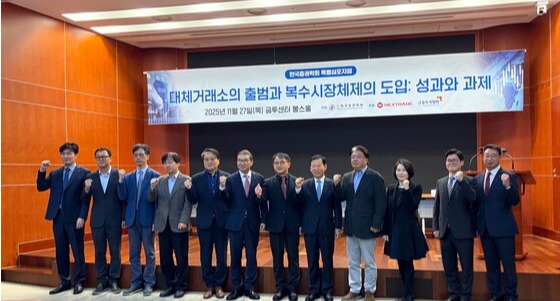
The Korea Securities Association held a special symposium on the launch of the alternative trading system and the introduction of multiple markets at the Financial Investment Center in Yeouido on Nov. 27. The event reviewed nine months of progress and discussed future tasks.
Academics, industry officials and related institutions praised NextTrade’s performance. They also said improving rules, including easing the current 15 percent market share cap and expanding eligible instruments, is urgent to enhance competition and investor benefits.
Korea Securities Association President Jeon Jinkyu said in opening remarks that the market shifted to a full multiple‑market structure with NextTrade’s launch in March. He said the change has expanded choice and improved efficiency for the capital market.
He said price discovery is working, citing cases where pre‑market prices differ from prices after the main session opens. He said issues such as liquidity dispersion, fees and market surveillance require objective review and institutional solutions.
Financial Investment Association Chairman Seo Yoo‑seok said NextTrade accounts for about 15 percent of total market volume despite being in its early stage. He said domestic investors have adapted quickly to the multiple‑market structure.
He said competition will need to shift from cost cuts to transparency, execution speed and quality. He said the association will work on market share rule adjustments and improvements to smart order routing standards.
NextTrade CEO Kim Hak‑soo said extended trading hours, faster execution, more order types and lower fees have emerged since the platform launched. He said he aims to build a NextTrade 2.0 that surpasses the current system.
He said the company will strengthen operational stability and review ATS‑related rules, including the market share cap. He said expanding to ETFs, fractional investments and STOs is also needed.
Sungkyunkwan University Professor Kim Daejin said multiple‑exchange systems are standard in advanced markets. He compared overseas cases with NextTrade’s current status.
He said NextTrade handles execution while listing, surveillance and clearing remain with the Korea Exchange. He said the platform has secured a meaningful share of trading despite its short history.
He said differentiated services, including midpoint orders, help improve efficiency. He also said risks such as order manipulation require careful review.
A panel discussion followed with views from academics, industry and institutions.
Korea National Open University Professor Lee Woobaek said the overall quality of the equity market has not deteriorated and in some cases improved after NextTrade’s launch. He said the 15 percent cap has become an issue earlier than expected due to rapid growth.
He said investors need advance disclosures on trading limit forecasts as part of regulatory improvements.
Dongguk University Professor Yoon Seonjoong said NextTrade’s strength lies in low fees and extended hours. He said more innovation will be needed if the main exchange expands trading hours.
Korea Investment and Securities researcher Yeom Dongchan said Japan’s PTS systems took more than a decade to reach 1 percent of trading, while South Korea exceeded 15 percent in under a year. He said lower costs and longer hours have raised price discovery opportunities and called for expanded trading in ETFs and STOs.
Financial Investment Association official Jin Yanggyu said foreign investors are watching NextTrade’s rapid growth and foreign securities firms are considering participation. He said early‑stage policy should promote competition rather than add rules.
He said activating SOR competition, easing the share cap and redesigning internal execution rules at firms are needed.
NextTrade Executive Director Kim Jinguk said the 15 percent cap triggers trade suspensions for some stocks and hurts stability. He said the company is seeking ways to protect both market stability and stock management and aims to reduce suspensions next year.
Financial Services Commission official An Youngbi said NextTrade has settled quickly, boosting trading during commuting hours and improving foreign investor access. She said the government will support healthy competition with the main exchange and promote lower fees and longer hours.
She said the market share rule is under review, taking account of its purpose and NextTrade’s fast growth. She said measures such as temporary exemptions for individual stock limits and grace periods for the 15 percent overall cap are being applied to increase predictability.
 Sangyeop Oh
yub@d-today.co.kr
Sangyeop Oh
yub@d-today.co.kr