
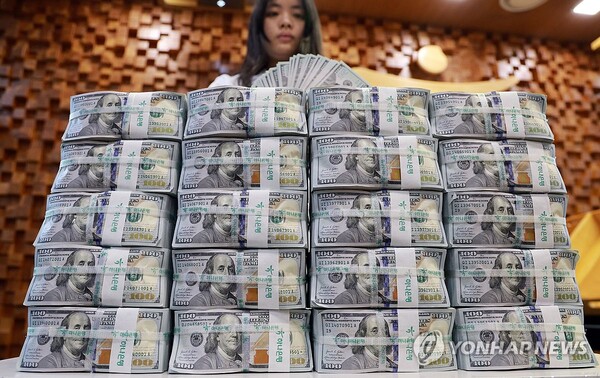
South Korea's foreign exchange reserves fell at the end of last year for the first time in 7 months after being used to manage exchange-rate volatility.
As of the end of December, the country's foreign exchange reserves stood at $428.05 billion, down $2.6 billion from the previous month, the Bank of Korea said on Monday.
Reserves fell to $404.6 billion at the end of May, the lowest level in about 5 years, then rose for 6 straight months through November to $430.66 billion. They failed to extend gains in December.
A Bank of Korea official explained that the reserves fell due to the impact of measures to ease volatility in the foreign exchange market, despite increases in foreign currency deposits at financial institutions from quarter-end effects and a rise in the U.S. dollar conversion value of foreign currency assets in other currencies.
By asset, securities such as government and corporate bonds, at $371.12 billion, fell by $8.22 billion.
Deposits, at $31.87 billion, and IMF special drawing rights (SDR), at $15.89 billion, rose by $5.44 billion and $150 million, respectively. Gold was unchanged at $4.79 billion because it is recorded at the purchase price rather than reflecting market prices.
South Korea ranked ninth in the world in foreign exchange reserves as of the end of November, based on $430.7 billion.
China had the most at $3,346.4 billion, followed by Japan ($1,359.4 billion), Switzerland ($1,058.8 billion), Russia ($734.6 billion), India ($687.9 billion), Taiwan ($599.8 billion), Germany ($552.3 billion) and Saudi Arabia ($463.7 billion) in second through eighth place.
[Yonhap]
 Online Team
d-today@d-today.co.kr
Online Team
d-today@d-today.co.kr