
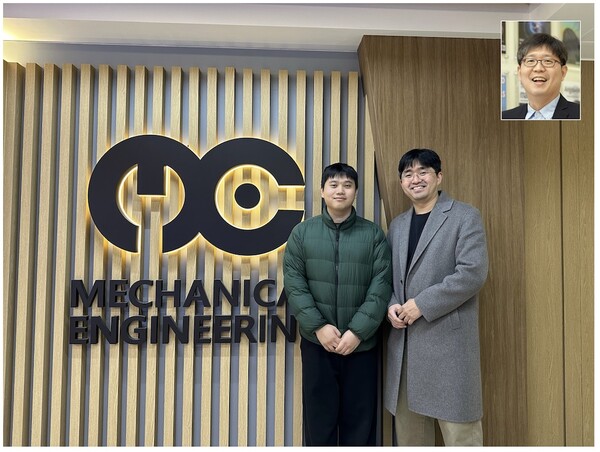
KAIST has developed a technology to produce vertical nanolasers using 3D printing. KAIST said on Monday that a team led by Professor Jitae Kim of the Department of Mechanical Engineering developed an ultrafine 3D printing technology to fabricate vertical nanolasers jointly with a team led by Professor Junseok Noh of POSTECH, which is headed by President Seong-geun Kim.
Vertical nanolasers are a key component for ultra-high-density photonic integrated circuits. Conventional lithography-based semiconductor manufacturing involves complex processes and high costs. It is difficult to freely change a device’s shape or position. Most existing lasers have a horizontal structure lying on a substrate, taking up space and losing efficiency as light leaks downward.
The team developed a 3D printing method that stacks perovskite vertically. Perovskite is a next-generation semiconductor material that efficiently generates light. The technology is an ultrafine electrohydrodynamic 3D printing technique that precisely controls ink droplets as small as an attoliter (10⁻¹⁸ L) using voltage.
The team directly printed nanostructures vertically at desired locations without complex processes such as removing material. The nanostructures are pillar-shaped and much thinner than a strand of hair. The team explained that it achieved a high-quality structure with crystals aligned almost as a single crystal by combining gas-phase crystallisation control with the printing process. It made the surface of the perovskite nanostructures very smooth to improve laser efficiency.
The team implemented a high-efficiency vertical nanolaser with low optical loss and stable operation. It proved it could precisely change the colour of the laser light by adjusting the height of the nanostructure. It also produced laser security patterns that are invisible to the naked eye and can be confirmed only with special equipment, and said it confirmed the possibility of commercialisation as an anti-counterfeiting technology.
Jitae Kim said, "This technology enables us to directly implement, at high density on a chip, semiconductors that compute using light without complex processes," and "It will bring forward the commercialisation of ultrafast optical computing and next-generation security technologies."
The results were published online in ACS Nano on Dec. 6, with Dr Shiqi Hu of the Department of Mechanical Engineering as the first author. The research was supported by the Ministry of Science and ICT’s Excellent Young Researcher programme, the Mid-career Researcher Support programme, and the InnoCORE AI-based Intelligent Design-Manufacturing Integration Research Group.
Jitae Kim said, "This technology enables us to directly implement, at high density on a chip, semiconductors that compute using light without complex processes," and "It will bring forward the commercialisation of ultrafast optical computing and next-generation security technologies."
 Daegeon Seok
d2dg@d-today.co.kr
Daegeon Seok
d2dg@d-today.co.kr