
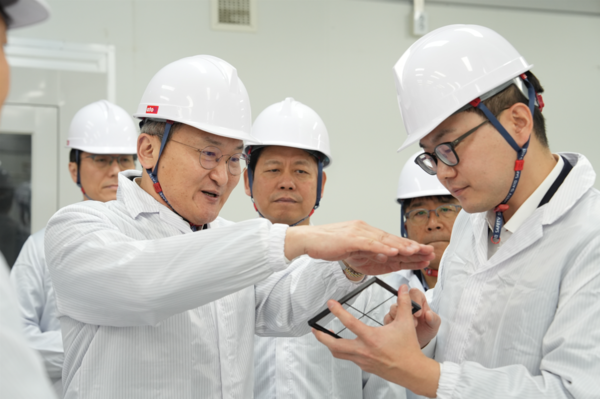
SK On and SK Innovation signed a memorandum of understanding on Jan. 5 at Standard Energy’s headquarters in Daejeon to develop vanadium-ion battery (VIB)-based energy storage system (ESS) technology, SK On said on Jan. 6. Attendees included SK On CEO Lee Seok-hee, Park Ki-soo, head of SK On’s Future Technology Institute, Kim Pil-seok, head of SK Innovation’s Environmental Science and Technology Institute, and Standard Energy CEO Kim Boo-ki.
Under the agreement, SK On will expand its product lineup to include VIBs, following NCM and lithium iron phosphate (LFP). The three companies will cooperate to improve VIB performance for short-duration ESS. A short-duration ESS stores and discharges energy in less than 4 hours. It is used in data centres and industrial facilities, where repeated operation in short periods is required, making safety and output performance key requirements.
Based on its battery mass-production experience, SK On will conduct technical cooperation spanning everything from raw material procurement to materials, cells and the battery management system (BMS). It will also push technology development, including large-area cell design. SK Innovation will improve material performance by developing electrolyte additives and cut costs by using vanadium recovered from refining processes.
A VIB uses an electrolyte whose main component is water, removing fire and explosion risks. Its high output makes it suitable for short-duration ESS. Standard Energy’s VIB ESS was installed in central Seoul under the industry ministry’s regulatory sandbox and operated without accidents. It was later installed in subway stations and inside buildings, where its safety was verified.
The second round of bidding in the ESS central contract market, currently under way early this year, used fire safety as a major criterion. SK On is targeting the market with an ESS that applies electrochemical impedance spectroscopy (EIS) technology to detect abnormal signs at least 30 minutes before a fire occurs. EIS is a non-destructive analysis technique that measures impedance by applying alternating-current signals at various frequencies to assess battery internal performance and condition.
Standard Energy developed an ESS VIB for the first time in the world. It has succeeded in VIB ESS demonstration and commercialisation and is supplying multiple clients. In March last year, it was named the only South Korean company on Time magazine’s list of the world’s best green-tech companies for 2025.
Lee said the cooperation would allow the partners to jointly develop vanadium-ion batteries for ESS with strong fire safety and further strengthen its product portfolio. He said it would provide customers with new value based on globally competitive technology.
Kim said Standard Energy would work with SK On and SK Innovation to commercialise vanadium-ion batteries faster, citing their complementary characteristics to lithium-ion batteries. He said the effort would create a new standard for ESS that can be used with confidence in environments such as data centres and indoor and urban settings where safety and performance are both required.
 Daegun Seok
d2dg@d-today.co.kr
Daegun Seok
d2dg@d-today.co.kr