
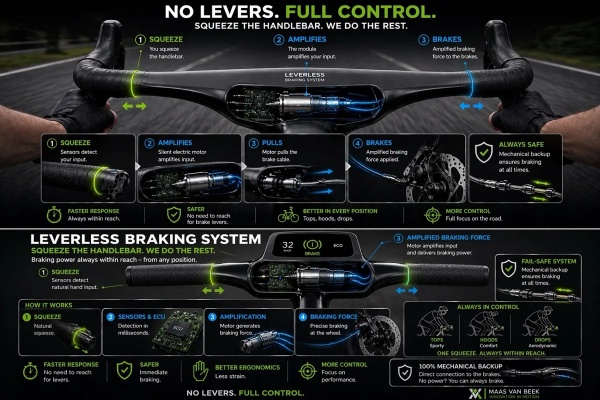
An electronic bicycle brake system has been proposed that brakes without brake levers, using only the act of gripping the handlebar. The idea is drawing industry interest as an attempt to fundamentally change a bicycle braking interface that has been maintained for more than 100 years.
BikeRadar, a mobility-focused outlet, reported on April 27 that Dutch inventor Maas van Beek (마스 반 베이크) unveiled a new braking structure that eliminates brake levers by using pressure sensors inside the handlebar and a central control unit.
In the system, sensors inside the handle grips detect the force of a user’s grip and transmit the signal to a central module, which activates the brakes. The key is that deceleration is possible without operating a separate lever, meaning riders do not need to change hand position while riding.
The developer focused on the fact that conventional bicycle brake structures have remained largely unchanged for more than a century. While other bicycle components have continued to develop, the braking interface has remained centered on levers. He described the design as “a challenge to the brake lever concept that has continued for more than 100 years.”
The system is designed to integrate braking functions into the handlebar itself so brakes can be used the same way from the top grips or in various riding postures. It also suggested the possibility of improved safety because it can reduce the time needed to move a hand to a lever in an emergency.
The development stems from real riding experience. Maas van Beek said he developed the idea after a situation in which a vehicle cut in and it was difficult to brake immediately while riding. He said, “It was a very short moment, but I lost braking control,” and added, “I realised how important that split second is.”
Structurally, it is not only an electronic input. The system includes a motor to assist braking force so sufficient braking is possible without the user applying excessive force. The concept is similar to a servo assist device used in car brakes. It also includes a mechanical backup device in case of an electronic system failure.
Its application is also not limited to a specific genre. The developer sees potential uses not only for performance road bikes that mainly use the tops of drop bars, but also for everyday bicycles. He described it as an approach to redesign the overall bicycle control system rather than a simple component improvement.
The current stage, however, is close to a concept design. A patent application and the design disclosure have been made, but there is still no working prototype. That means verification is needed for commercialisation, including brake response speed, durability and how failures are handled.
The developer plans to pursue collaboration with bicycle brands and parts manufacturers. Whether the new braking method that removes brake levers will lead to an actual product is likely to depend on prototype development and whether industry partners are secured.
 Jinju Hong
hongjj@d-today.co.kr
Jinju Hong
hongjj@d-today.co.kr