
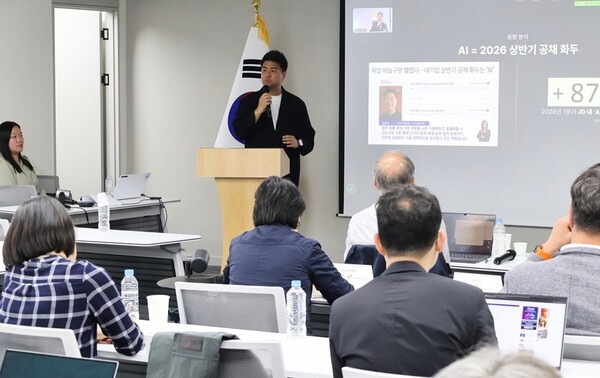
[Digital Today reporter Chi-gyu Hwang] Worksphear on April 23 took part in the National Artificial Intelligence (AI) Strategy Committee's "Relay Forum for a Major Overhaul of Talent and Education Systems in the AI Transition Period" and shared the direction of changes in the youth job market and policy responses needed in the AX (AI Transformation) era.
Speaker Jun-su Kim (김준수), head of Value Growth and chief human resources officer (CHRO) at Worksphear, diagnosed structural changes in the employment market based on actual hiring data and presented the role of an HR platform to ease mismatches between talent and companies.
Kim said the structure was not that AI had reduced jobs but that "talent density" had increased. He said the number of job postings was holding steady but applicants were increasing, lifting applicants per posting by 13 percent and pushing the document-pass rate down to about half, creating a high-density competitive environment.
He added that while 89 percent of companies were hiring, more than 60 percent were failing to meet their hiring targets. He said the core issue was not a decline in hiring but "higher matching difficulty", namely mismatches.
He also stressed that AI was reshaping the labour structure rather than replacing jobs. Worksphear data showed AI-related job postings rose 112 percent over the past five years, and demand was expanding rapidly among entry-level jobs and in non-capital regions as well.
Kim said market demand was shifting toward talent that can use AI and that AI-use capability was becoming a basic requirement across most jobs, including marketing, HR and planning, not just development. On the direction of talent development, he suggested that reskilling policies that support job transitions and redesigning capabilities were important to ease employment anxiety felt by young people, rather than an approach focused simply on increasing the number of jobs. He also suggested that a more precise employment response would be possible when private-sector hiring data and public policy were combined.
 Chi-gyu Hwang
delight@d-today.co.kr
Chi-gyu Hwang
delight@d-today.co.kr