
Last summer, the tariff shock from U.S. President Donald Trump’s administration swept the world. South Korea was no exception. As a policy imposing tariffs on most mail items bound for the United States took effect, Korea Post’s international express mail service (EMS) also effectively ground to a halt. Korea Post suspended acceptance of EMS items from Aug. 26 for all goods except documents that are not subject to tariffs.
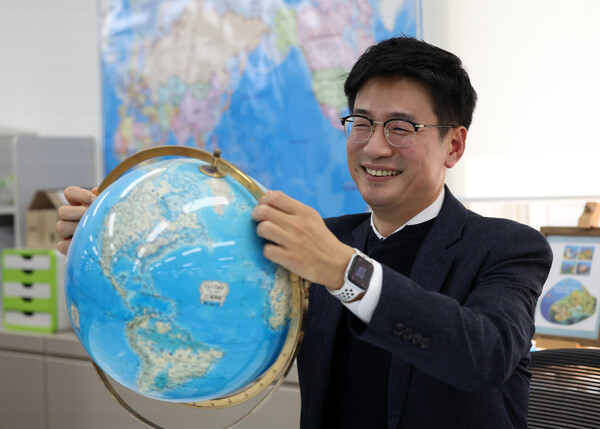
Yoon Seok-jun (윤석준), head of international business at Korea Post, recalled the time in an interview with DigitalToday, saying, "It was a really big emergency." With U.S.-bound EMS work halted, reverse direct purchasers who brought goods into the United States from South Korea, international students who needed essential items delivered from South Korea and small exporters all faced difficulties. Korea Post presented its private partnership product, "EMS Premium," as an alternative, but it was not a complete substitute because shipping fees for low-weight items were higher than EMS.
Korea Post had no choice but to suspend EMS acceptance because it did not have a settlement system in place. Previously, tariffs for U.S.-bound EMS were borne by recipients who received the goods locally. But after the U.S. tariff policy change, tariffs had to be calculated in advance in South Korea and reflected in EMS fees. Building an electronic system to support a kind of prepayment became urgent.
Korea Post immediately activated an emergency response system to resume EMS. It formed a four-team task force: an overall situation team, an IT development team to shorten the system development schedule, a public response team to handle complaints and an overseas communications team to meet with foreign developers and monitor trends. It also set up a separate task force within the Postal Information Service, which is in charge of system development, and concentrated development resources.
The biggest challenge was building a tariff-advance-payment system. Post office counters had to be able to calculate tariffs and take payment immediately. Korea Post began discussions on work processes and started developing a system reflecting the new tariff policy as soon as a U.S.-approved local tariff payment agent was designated. It also held several rounds of talks with related agencies, including U.S. Customs and Border Protection (CBP) and the U.S. Postal Service (USPS), to seek ways to resume the service. Yoon said, "We worked on system development while communicating with the U.S. local tariff payment agent day and night, including on weekends."
The intensive response produced results much faster than expected. System construction that was initially expected to take at least 90 days was completed in just 22 days. This made South Korea the second country in the world, after Britain, to resume U.S.-bound EMS service. Yoon said, "Because it was a situation that required overcoming physical distance and time differences, we actively used video conferences and emails," adding, "It was the result of concentrating all available capabilities to normalize EMS."
The case was also assessed as a representative example of government-led "proactive administration." The Ministry of Science and ICT selected the resumption of EMS service as one of the best proactive-administration cases in the fourth quarter of last year, saying, "Through proactive response, it minimized inconvenience to the public and secured the stability of international mail services."
Korea Post is also accelerating efforts to strengthen the competitiveness of its international mail services based on this experience. It recently expanded the countries accepting its "K-Packet" product, which is specialized for shipping small items weighing 2 kg or less, to 51 countries from 20. The move aims to respond to rising demand for so-called "K-culture" products such as K-pop goods, cosmetics and accessories.
It is also pursuing policies to ease user burdens, including fee discounts and a freeze on additional charges. Yoon said this strengthens its role as a public institution, such as by refraining from raising extra costs despite rising aviation fuel costs.
He said, "It is our duty to respond proactively to changing environments and minimize inconvenience to the public," adding, "We will continue to work so that the public can send international mail abroad more conveniently."
 Jin-ho Lee
jhlee26@d-today.co.kr
Jin-ho Lee
jhlee26@d-today.co.kr