
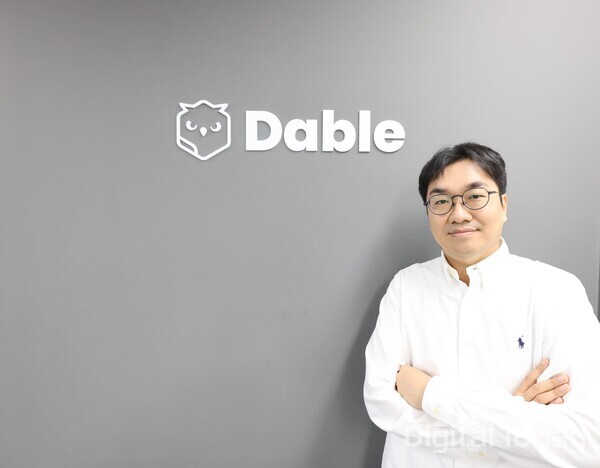
[DigitalToday reporter Seulgi Son] "In the era of artificial intelligence, the human role is choice, taste and responsibility. Only by handing all execution to agents can people fill their day with judgment."
Ha Yong-ho (하용호), chief data officer at Dable, emphasised that increasing the time spent on judgment is a way to boost individual competitiveness through AI agents.
In an interview with the reporter, he said working-level staff spend about 20 to 30 minutes of an 8-hour day making discretionary judgments, while decision-makers fill 6 hours with choices. He said increasing time devoted to judgment is important for personal survival in the AI era. He said people should build the capability to operate advanced agents and focus on judgment and choice.
Ha is an expert who has worked in data and AI for more than 20 years after stints at TmaxSoft, KTH and Kakao. He started by developing large-scale search engines and data processing systems and later worked across financial quant work, cloud infrastructure and AI recommendation algorithms. He currently oversees Dable's recommendation and advertising engines as CDO and also serves as a member of the Presidential National AI Strategy Committee.
Ha already uses a range of AI agents in practice. The agents he built go beyond simple task automation. They record all meetings, automatically transcribe them and extract only his remarks through voiceprint analysis. He stored years of meeting minutes in a central data repository and linked it to Telegram, KakaoTalk, Slack, Jira, Notion, Calendar and Drive. By training on those data, he created an AI persona that analyses his behaviour patterns, thinking patterns, preferences and underlying psychology.
He said he regularly checks whether the agent's judgment matches his own choices and makes corrections. Ha said he is making small daily adjustments, likening it to an old man carving a wooden bat. He said when a difficult judgment arises, three models, Claude, Codex and Gemini, each put forward a claim of what "Yong-ho would do". After hearing one another's arguments, they go through a process of reaching agreement, and only the final result comes to him. He said the structure is designed to produce an answer with a high likelihood of being his true choice.
He said agents cover his daily life broadly. He said an agent handles ordering at the company's cafe by opening the web page, logging in and completing payment. At home, it can open curtains or close windows when carbon dioxide levels in the main bedroom rise above a certain level. He said when a "let's eat" message arrives on Telegram, it is enough to say "add it to the calendar".
The cost of operating the AI agents is about 400,000 won a month. Ha said he runs them on one Mac mini with one Claude Code account that costs $200. He said he uses the cheaper Haiku or Sonnet models for small tasks, and Opus for high-difficulty judgment or debate.
He said building advanced agents requires changing the approach from the perspective of system design.
He said the key is to create the tools, workflows and materials from the outset on the premise that AI will use them. He said the ultimate user of every tool at a company is AI. He said you can tell whether real AI transformation has happened by checking whether systems have been reorganised to make them easy for AI to use.
He said the standard for an "AI-native company" will ultimately be divided by who does the work.
He is currently an adviser to Hashed, a blockchain-focused venture capital firm, and is helping AI-native founders aiming for a "one-person unicorn". He said the investment community says having more than 4 people is too many. He said they no longer assume people will do the work. He said a company where work does not run after people leave for the day is a Paleolithic company.
Established companies would find it hard to keep up in decision-making methods and speed. He said he is often surprised when talking with AI natives. He said while he was saying they should set up a retention-based personalised journey, they kept typing as they listened. He said when he looked at what they were doing, they turned the screen at the end of the conversation and showed a serving system already running on their actual data. He said it was a live service, not a mock-up, and that what a typical company might see after several internal meetings and a month was implemented in real time and released immediately as a service.
He maintained that uniquely human domains still exist. He said people who have choice, taste and responsibility will not be replaced by AI. He said even if AI can present optimal options, choosing among them is for humans. He said even if it is not the optimal choice, taste leads to the right choice. He said it is also important to take responsibility for the result, regardless of what tool is used, rather than saying AI says it is so.
The data solutions industry where Ha works is also focused on advancing through AI. Dable combines first-party data with AI to provide high-complexity advertising services that go beyond gender and age classification by reflecting time of day, location and recent behavioural history. He said it is possible to predict what a man in his 20s might like, but asked what if he saw a game screen just before passing through a subway at 7 a.m. He said AI is used to find what someone will like within high complexity.
He said advertising is also necessary to monetise AI. He said YouTube, Instagram, Meta and even OpenAI ultimately intend to make money through advertising. He said advertising has been the way AI makes money for decades.
He predicted that in 5 years the public will also have dozens of agents. Ha said a butler agent will command many agents under it, and he will likely communicate only with the butler. He predicted that while people need to study to have all this now, in 5 years they will only need to pay money.
 Seulgi Son
sageson@d-today.co.kr
Seulgi Son
sageson@d-today.co.kr