
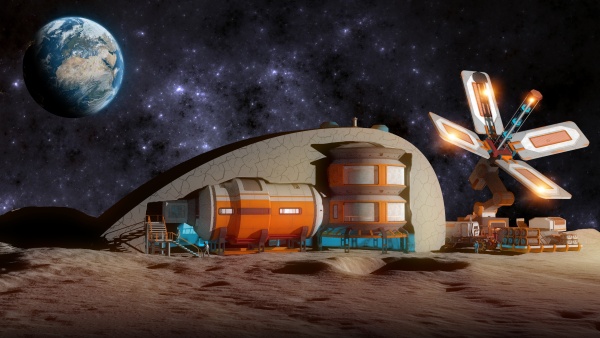
As the private space industry presents lunar habitation as a realistic goal, human and environmental risks that could block long-term stays are also coming into focus. Competition that centred on launch vehicles is shifting toward habitation infrastructure and survival technology.
On April 24 local time, CNBC reported that Dylan Taylor (딜런 테일러), chief executive of U.S. space company Voyager Technologies, said at an event in Singapore that humans would reach the moon in the late 2020s and that bases equipped with life-support systems would then be built. He forecast that living and working on the moon would become possible in the early 2030s. He said inflatable habitats and basic life-support systems would be the initial form.
The remarks align with a trend in which private companies set the "lunar economy" as a next growth engine. SpaceX aims in the long term to build a self-sufficient lunar city, and Blue Origin has said it would focus on building a permanent lunar foothold. Competition to build infrastructure linking low Earth orbit and the moon appears to be accelerating.
Investment conditions across the space industry also appear to be strengthening. About $45 billion flowed into low Earth orbit, defined by NASA as below 2,000 km, in 2025, a sharp increase from the previous year, and talks on building space data centres have begun. Some companies are already testing satellite-based data processing and AI analysis functions. The possibility has been raised that data centres could be operated in space within the next five years.
But separate from technological optimism, the challenge of humans surviving on the moon for long periods remains a high barrier. As discussions on long-term lunar stays gain momentum after NASA's Artemis II, the effects on the human body have emerged as a core task.
According to online media Gigazine, physiologist Damian Bailey (데미안 베일리), a professor at the University of South Wales in Britain, pointed out that the lunar environment could burden nearly every organ system in the human body. The moon brings together one-sixth of Earth's gravity, strong cosmic radiation, extreme temperature swings, harmful lunar dust, disrupted sleep cycles and long-term isolation.
Radiation in particular is the biggest risk factor. On the moon, which lacks the protection of Earth's magnetic field, risks of DNA damage, weakened immunity, and cardiovascular and nervous system abnormalities could rise. The low-gravity environment could also alter blood and oxygen circulation and may cause long-term dysfunction.
Key countermeasures include exercise, nutrition management and radiation shielding technology. As astronauts exercise for more than two hours a day on the International Space Station, systems are needed on the moon to maintain muscle and bone density. Analysis suggests that artificial gravity using centrifuges, personalised nutrition design and multi-layer radiation protection strategies should also be pursued in parallel.
Physiological monitoring through wearable sensors and real-time data analysis is also becoming important. If small abnormal signals are not detected early and addressed, the long-term mission itself could be threatened.
Ultimately, the outcome of the race to build lunar bases goes beyond simple landing technology. How precisely housing, energy and data-processing infrastructure are built, along with medical and operational systems to sustain human survival, is emerging as a key variable. As private companies and governments pick up speed at the same time, assessments say the moon has entered an early stage of shifting from an exploration target to an actual "living space."
 Jinju Hong
hongjj@d-today.co.kr
Jinju Hong
hongjj@d-today.co.kr