
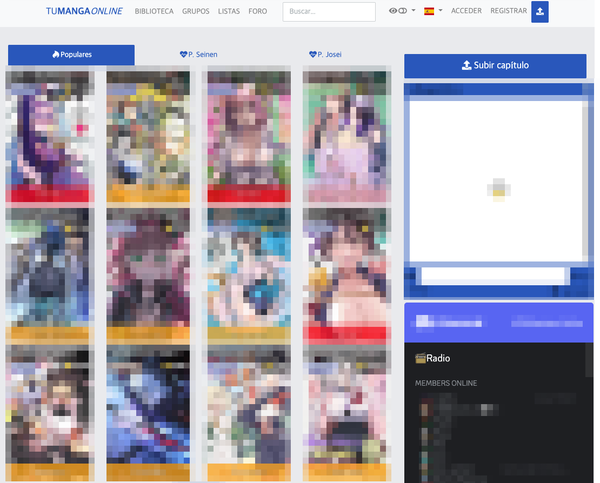
Naver Webtoon, Kakao Entertainment and other major South Korean webtoon rights holders have shut down the large Spanish-language piracy site TuMangaOnline and multiple related sites in cooperation with the Copyright Overseas Promotion Association (COA), they said on April 27.
The measures were carried out by Spanish judicial authorities. It is the first case in which South Korean webtoon rights holders directly responded overseas under local law and achieved results. Participants included Kakao Entertainment, the COA chair company, as well as Naver Webtoon, Lezhin Entertainment, Ridi, Kidari Studio, Toomics and Topco Media, among COA member webtoon rights holders.
TuMangaOnline is a large piracy site that has operated an illegal webtoon service for years targeting Spain and Latin America. Rights holders said they confirmed the site recorded about 86 million visits in March last year alone. Based on the site analysis service Similarweb, it ranked 327th globally, 87th in Spain and 26th in Mexico, a level of traffic similar to major Spanish daily newspapers. Rights holders estimate the damage suffered by South Korea's content industry over several years due to the sites exceeds several tens of billions of won.
The shutdown process began with rights holders' long-term investigation. They identified the site's operators living in Spain through a lengthy probe. Based on that, COA worked with an overseas IP response specialist company, a local law firm, local investigative agencies and judicial authorities to pursue 대응. Spanish police secured evidence through an investigation after receiving the rights holders' criminal complaints and obtained search and seizure warrants from a court. The shutdown followed the execution of the warrants by investigative authorities, and the case is now awaiting the start of a formal criminal trial.
Lee Ho-jun (이호준), head of the legal office at Kakao Entertainment, said, "We will continue to strengthen private-led efforts to respond to copyright infringement at home and abroad and do our best to ensure organic public-private cooperation."
 Ho-jung Lee
lhj@d-today.co.kr
Ho-jung Lee
lhj@d-today.co.kr