
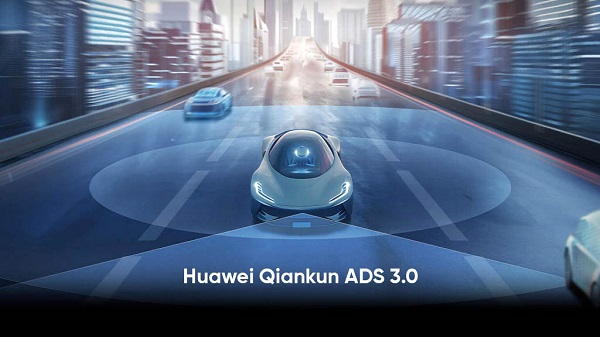
Huawei will invest up to 80 billion yuan ($11.0 billion) over the next five years to expand computing capacity needed for training and testing self-driving cars.
On April 24 local time, the South China Morning Post reported that Huawei has moved to make large capital expenditures to maintain its lead in supplying smart driving systems in China.
The investment aims to improve the reliability of vehicles equipped with Huawei's advanced driver-assistance system Qiankun ADS and to increase the number of client companies. David Wang (진위즈), chief executive of Huawei's Intelligent Automotive Solution Business Unit, said at an event in Beijing that the company plans to allocate 18 billion yuan ($2.5 billion) to autonomous-driving research and development in 2026 alone.
Wang called autonomous driving an industry that requires long-term investment. He said that based on the 18 billion yuan being invested in smart driving this year, Huawei's spending will exceed the combined total of other major autonomous driving solution companies.
Huawei is putting particular emphasis on computing infrastructure. The ability to process vast amounts of data collected during learning and verification is seen as key to improving ADAS performance. Huawei plans to invest pre-emptively in this area to raise both system stability and performance.
The market base is also growing rapidly. The Qiankun ADS platform surpassed 10 billion km in cumulative autonomous driving distance earlier this month. Huawei is working with 25 car brands in mainland China and has applied Qiankun to more than 50 models. Deliveries of vehicles equipped with the system total 1.7 million units.
In the scale of accumulated real-world driving data, Tesla is cited as virtually the only comparable peer. David Zhang (데이비드 장), secretary general of the International Intelligent Vehicle Engineering Association in Shanghai, assessed that some Chinese ADAS performed better than Tesla's Full Self-Driving software, FSD, on Chinese roads. He added that China's autonomous driving technology still remains in the domestic market, while FSD leads in international markets.
Huawei is strengthening its position as a supplier of vehicle systems and core components rather than as an automaker. It supplies automotive chips, lidar sensors and in-vehicle internet connectivity technology to Chinese automakers such as Arcfox and Avatr to support implementation of semi-autonomous driving functions.
That strategy became clearer after cooperation with Seres in 2021. Aito, an electric vehicle brand created by the two companies, is now one of the major selling brands in China's premium electric vehicle market. Seres later decided in mid-2024 to buy Aito's trademark rights and patents from Huawei for 2.5 billion yuan, a case cited as showing Huawei's direction of strengthening its role as a supplier of vehicle systems and know-how rather than an EV manufacturer.
Huawei says it can help automakers cut development costs, speed up new model launches and improve the efficiency of smart driving system testing. Against that backdrop, major Chinese automakers are accelerating development of self-driving cars with hands-off functions to secure an edge in an increasingly competitive market.
The regulatory environment is also changing. Beijing in December last year for the first time allowed some companies to produce electric vehicles equipped with Level 3 autonomous driving functions. Level 3 vehicles can drive on their own under set conditions, but drivers must remain ready to intervene immediately if needed. As a result, Huawei's large investment is increasingly likely to further intensify competition to supply smart driving systems as China's auto industry shifts toward Level 3.
 Jinju Hong
hongjj@d-today.co.kr
Jinju Hong
hongjj@d-today.co.kr