
Ahead of the early May holiday period, mobility platforms are widening their business footprint into festivals and tourism. It is a B2G and B2B2C strategy that links accumulated movement data and user bases with demand from local governments, events and tourists, and turns that into data monetisation. The scope is expanding beyond simple ride-hailing and navigation to event operations, group travel and enforcement alerts.
Mobility companies have recently been rolling out services that target movement demand by turning data they hold into a source of revenue. Their strategy is to respond in earnest to domestic travel demand, from the early May holiday period through the spring cherry blossom season and into summer festivals and events. Large venues have repeatedly faced parking shortages, traffic congestion, complaints about enforcement and inconvenience for foreign tourists travelling in groups, and this is opening new business opportunities for mobility platforms.
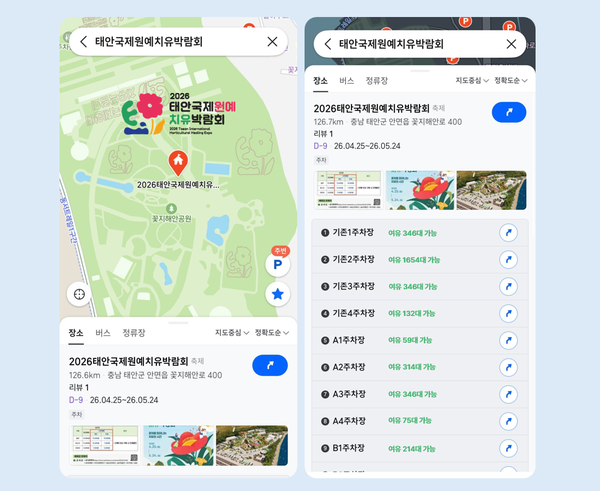
TMAP Mobility is increasing cases that connect data analysis to local government event operations. It recently said it will apply its "festival movement AI solution" to the 2026 Taean International Horticulture Healing Expo. The service supports route guidance that considers congestion points and disperses parking demand, based on visitor movement data.
During the event period, it provides guidance reflecting real-time parking availability at nearby temporary lots. After the event, it provides local governments with reports analysing visitor characteristics and stay patterns. It is a structure that integrates support across the full process, from pre-event promotion to on-site movement management and post-event data analysis. TMAP Mobility applied the same solution last year to the Chuncheon Marathon and to areas around Naejangsan and Suncheon Bay in cooperation with the Korea Tourism Organization.
Jun Hyun-ho (전현호), TMAP Mobility data business leader, said, "It is meaningful in that it is a case that eases congestion at festival sites based on visitor movement data and supports post-event analysis as well."
It is also working to strengthen user touchpoints. TMAP Mobility recently revamped its home screen by placing the map at the forefront. It also released "My Theme Course" content in which users introduce restaurants and travel routes themselves. It is a move to extend movement data into place discovery and social features.
The shift is to combine accumulated movement data with external demand such as local government event operations, transport to concerts and festivals, group travel for foreign tourists and parking and stopping alerts. A clear trend is emerging in which mobility platforms move beyond their own fare revenue and commercialise data itself. Through such combinations, local governments gain a means to supplement limits of existing responses centred on securing temporary parking lots and deploying on-site personnel, while event organisers and tourism operators can secure both transport channels and post-event analysis materials.
Kakao T Shuttle, run by Kakao Mobility, is an example targeting concert and festival demand. Shuttles have been opened in succession for events including Weverse Con Festival, a SHINee concert, King Gnu's concert in South Korea, the Seoul Music Awards and the Danjong Cultural Festival. Seats are available via advance reservation with limited capacity, and shuttle prices range from 22,000 won to 50,000 won depending on the event and route. It broadly covers areas where group travel occurs, from concerts and local festivals to marathons, fishing and small gatherings.
Socar signed a business agreement in September last year with the Ministry of the Interior and Safety and Korail to revitalise depopulating regions, and is running a related discount programme. The main plan is a 55 percent discount on rental fees at major Socar zones in 89 depopulating regions through August. Eligible discounts include not only Socar zones within those regions but also Socar zones near transport hubs in other regions that have a high share of trips to depopulating areas, to increase practical use. It is also separately providing 55 percent discount coupons that can be used when visiting local areas such as Gimhae and Yangsan.
There are also moves targeting group travel by foreign tourists. Uber Taxi recently launched a premium mobility service called "Premier Van". It targets demand for airport trips, golf and family travel with vehicles that can carry up to 5 passengers and load up to 4 pieces of 30-inch luggage. It operates on a pre-confirmed fare system, removing the burden of fare fluctuations due to traffic congestion. It plans to expand service areas starting from Seoul and add a large-taxi service in Jeju, where foreign demand is high. Uber Taxi said, "Demand for group travel and cargo space has increased among tourists, so we launched Premier Van," and expressed its intention to enhance convenience for foreign tourists' travel.
Support is also growing to help address potential issues for customers, that is, mobility user groups. It is also a way for the industry to secure data. The mobility app Whistle recently opened a parking and stopping enforcement alert service in Ulju County, Ulsan, targeting outing demand. Tourist infrastructure where visitor numbers increase is subject to the service. If a vehicle is parked in an enforcement CCTV area, it sends a free advance alert text message to prompt the driver to move. With a single sign-up, users can receive integrated alerts across partnered areas nationwide, targeting travellers in unfamiliar regions.
Whistle currently provides parking and stopping alert services in cooperation with 90 local governments. According to the operator, alerts via Whistle totalled 7,608,576 cases last year, up 26.6 percent from a year earlier. If simply converted using a 40,000 won fine for passenger cars, it is analysed as an effect of saving about 304.3 billion won. Whistle has 5.87 million cumulative users and 5.54 million registered vehicles.
This trend is seen as part of a process in which the mobility industry shifts its positioning from unit-price competition through cost reduction to becoming operators of mobility ecosystems. An industry official said, "As companies go through the holiday period and the summer peak season, success in monetising movement data will depend on which demand groups and event and tourism categories each company pre-empts."
 Seok Dae-geon
d2dg@d-today.co.kr
Seok Dae-geon
d2dg@d-today.co.kr