
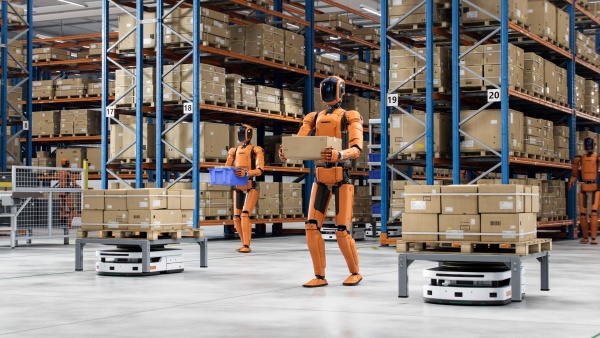
A forecast says half of newly built warehouses in advanced economies by 2030 will be designed as robot-centric facilities. Automation aimed at coping with rising costs and labour shortages is spreading across the logistics industry.
On April 23, IT outlet TechRadar reported that U.S. information technology research and advisory firm Gartner defined the shift as a structural transition rather than a simple adoption of technology. It said rising labour costs, workforce shortages and avoidance of repetitive work are combining to push companies to strengthen strategies to maintain throughput through automation.
A key point is that robots are moving from support tools to the central pillar of operations. Gartner supply chain analyst Abdir Thunka said artificial intelligence is optimising warehouse environments in real time and turning fixed logistics structures into flexible systems. As a result, warehouse design is being reorganised around efficient fleet operations rather than human work efficiency.
Human roles are also expected to change. Gartner said human labour will increasingly focus on handling exceptions rather than core execution tasks. Robots and automation systems will take on repetitive and standardised work, while people concentrate on managing variables and oversight that systems cannot handle.
The digitisation of warehouse operations is also accelerating. Digital twin technology is expected to expand beyond a design-stage tool into a real-time operations management system, and to be used to continually optimise routes, inventory placement and task allocation. Ian Davidson (이안 데이비드슨), head of product marketing at Wireless Logic, said the digital twin is "evolving from a planning tool into the nervous system of operations."
As automation expands, dependence on data accuracy and system connectivity also increases. If data flows are inconsistent or system connections are unstable, the reliability of automated decision-making could be undermined. Experts point to incident response and ensuring system resilience as key tasks, especially in large-scale logistics environments.
Another analysis says the success of warehouse automation depends not only on robot performance but also on the operating infrastructure that supports it. Stable connectivity, sensor-based mapping and video safety systems must be in place to sustain operations.
The industry expects warehouses to be redefined as operating systems where AI and robots run continuously rather than simple storage spaces. With less human intervention, data quality and network stability are expected to be key variables determining the pace of automation.
 Jinju Hong
hongjj@d-today.co.kr
Jinju Hong
hongjj@d-today.co.kr