
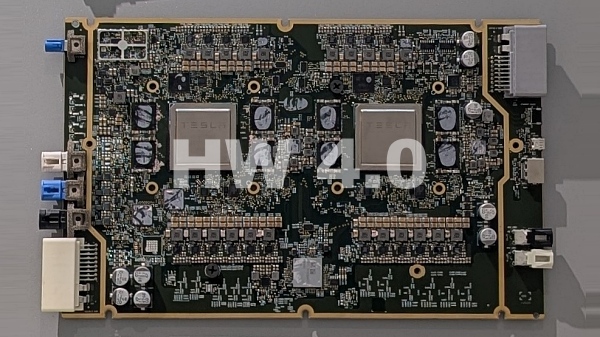
Tesla is preparing an upgraded successor to its HW4 autonomous-driving computer, dubbed HW4 Plus.
On April 23 (local time), EV outlet Electrek reported that Elon Musk (일론 머스크), Tesla's chief executive, said on a first-quarter 2026 earnings call that a new chip called AI4.1 or AI4 Plus will double memory capacity from the current version. RAM per chip will increase to 32 gigabytes (GB) from 16 GB, bringing total system memory to 64 GB.
Musk disclosed the plan while explaining the timing for applying the next-generation AI5 chip to vehicles. Tesla currently judges that unsupervised Full Self-Driving (FSD) is possible even with AI4, and plans to apply AI5 first to the Optimus robot and data centres. AI4 Plus is expected to enter production next year on the premise that Samsung completes its modification work. The current AI4 chip is manufactured on Samsung's 7-nanometre process.
The same earnings call also reaffirmed the limits of HW3. Musk acknowledged that HW3 would be difficult to use to implement unsupervised FSD, and pointed to memory bandwidth as a key bottleneck in particular. He said memory bandwidth determines performance in AI inference and explained that HW3's bandwidth is only one-eighth of HW4's.
The remarks raise new questions for consumers already driving HW4 vehicles. Tesla has stressed that HW4 is sufficient while also rolling out successive upgrades. Some Model Y vehicles produced at the Fremont factory in January 2026 were reported to be equipped with a so-called AI4.5 computer. The version is presumed to have changed from a two-chip structure to a three-chip design, but Tesla has not officially announced it.
Recent developments suggest three revisions in about two years, from HW4 to AI4.5 to AI4 Plus. This shows that while Tesla argues autonomous driving is possible with the current generation of hardware, it is in practice continuing to raise memory and computing performance.
The direction of technical improvement is also clear. AI4 provides about 384 GB per second of bandwidth based on GDDR6 memory, a major improvement over HW3's LPDDR4 memory. However, total memory capacity was limited to 32 GB, prompting criticism that it was lacking compared with competing chips. HW4 Plus focuses on addressing this by expanding memory to 64 GB and further improving bandwidth.
Tesla has sold millions of vehicles equipped with HW3 since 2019, claiming that every vehicle has the hardware needed for FSD. FSD software costs as much as $15,000 (about 22.3 million won). But after it was confirmed that HW3 cannot support unsupervised FSD, Tesla has even reviewed a plan to build a "micro factory" to retrofit about 4 million vehicles.
In this situation, despite Tesla's claim that AI4 is sufficient, market attention is likely to focus on how it will handle existing HW4 vehicles after HW4 Plus is released. The decision to apply AI5 to robots and data centres before vehicles also shows that a shift in the vehicle platform will not be easy.
 Seung-a Yoo
ysah@d-today.co.kr
Seung-a Yoo
ysah@d-today.co.kr