
Motif Technologies, a developer of proprietary AI foundation models, is seeking differentiation by promoting its own platform instead of Nvidia software tools.
It says using Nvidia’s general-purpose tools makes it impossible to beat big tech companies that lead in computing power. Motif is focusing on building and operating large language models as cost-effectively as possible with tools it developed in-house.
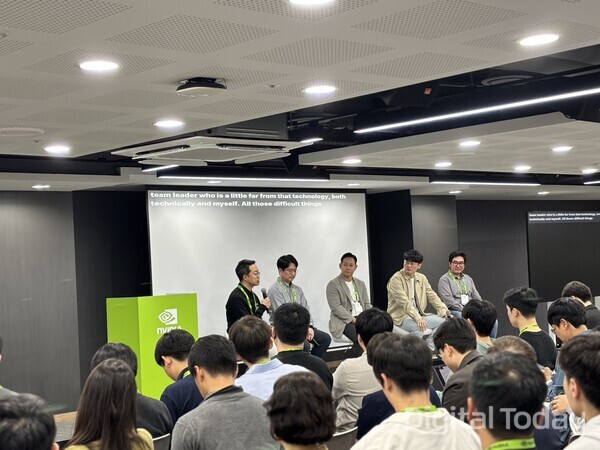
Jung-hwan Lim (임정환), CEO of Motif Technologies, joined a panel discussion at 'Nvidia Nemotron Developer Days Seoul 2026' held at D.CAMP Mapo in Seoul on April 22. He cited flexibility as the reason Motif developed its own tools instead of relying on Nvidia.
Lim said Nvidia tools offer limited flexibility for developers and can lead to users being confined within Nvidia’s ecosystem.
Nvidia’s CUDA can efficiently handle the large-scale computations needed to train AI models and has become a de facto standard in the AI development ecosystem, but it works only on Nvidia GPUs. Nvidia bundles training frameworks (Nemo and Megatron), inference optimisation tools (TensorRT-LLM) and a data curation solution (Nemo Curator) on top of the CUDA platform. That is why it has become industry practice to use the software package along with adopting Nvidia GPUs.
Other participants in the proprietary AI foundation model effort developed LLMs using Nvidia tools. SK Telecom used Megatron-LM and Nemo Curator to train its large-scale model A.X K1, and LG AI Research applied the Nemo framework and TensorRT-LLM across the entire development process for Exaone.
Motif has not rejected Nvidia hardware and CUDA itself. Lim described it as "similar to using an iPhone but not using the basic memo app," adding, "We use GPUs and CUDA, but we do not use the model development tools provided on top of them."
Lim said using Nvidia software for model development traps developers in a structure where they have no choice but to use Nvidia-supported architectures and methodologies. He said it takes too much time to modify code to use the Nemo family of software and that it has countless internal condition branches, so Motif judged it would be better to do it directly.
Motif says its in-house software strategy can be a point of differentiation in developing more competitive LLMs. Lim said if the architecture, data and methodology are the same, the side with less computing power cannot win, and that overcoming it requires trying in other areas.
He said staying within Nvidia’s software ecosystem ultimately forces developers to use the same architecture and methodology, making it impossible to beat big tech firms that lead in computing power.
Lim’s philosophy reflects development experience from his time at Motif’s parent company, AI infrastructure firm Moreh. Moreh developed its own AMD GPU-based training platform, MoAI. Lim led development of the MoMo-70B model based on AMD MI250 GPUs while serving as AI director at Moreh.
The company said the core of Motif’s proprietary software technology is its self-designed attention structure, GDA, or Grouped Differential Attention. Attention is a key computation that allows AI models to grasp relationships between words in a sentence, but it has a noise problem in which it reacts to unnecessary information. Motif improved this by allocating computing resources asymmetrically between groups that preserve signals and groups that control noise.
Motif also adopted Muon instead of the standard algorithm used by most AI companies, AdamW, for its training algorithm. Muon is an algorithm that adjusts parameter update directions during training so they do not conflict, enabling more learning with the same computation, and Motif parallelised it to run simultaneously in an environment of thousands of GPUs.
The company also stressed that in the inference stage it uses open-source vLLM instead of Nvidia TensorRT-LLM, while replacing core attention computations with Motif’s own implementation.
 Seulgi Son
sageson@d-today.co.kr
Seulgi Son
sageson@d-today.co.kr