
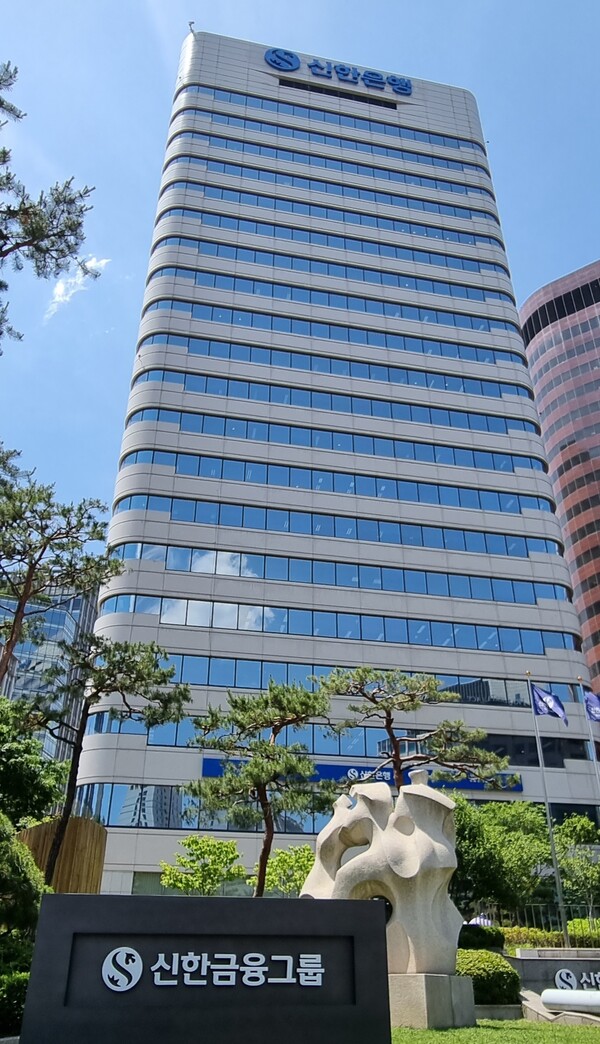
Shinhan Financial Group said on Wednesday it posted first-quarter net profit of 1.62 trillion won, up 9.0 percent from a year earlier. Improved non-interest income led by securities drove the profit increase, while interest income kept a stable trend. Selling and administrative expenses and credit loss costs were also managed steadily.
By segment, net interest income rose 5.9 percent on year to 3.02 trillion won. It reflected a 3 basis-point rise in the group’s net interest margin (NIM) and a 5 basis-point rise in the bank’s NIM, as well as the impact of asset growth. From the previous quarter, NIM improved, but interest income stayed at a similar level due to effects such as the number of days.
Non-interest income rose 26.5 percent on year and 106.7 percent from the previous quarter to 1.19 trillion won. Fee income, gains related to securities and insurance income expanded overall. In particular, securities profit and loss, which had been weak in the previous quarter, recovered and widened the improvement in results.
Selling and administrative expenses rose 9.3 percent on year to 1.55 trillion won, but fell 22.1 percent from the previous quarter. They increased from a year earlier due to voluntary retirement costs and the impact of an education tax, but declined as large one-off costs in the previous quarter disappeared. The cost-to-income ratio (CIR) held at a stable 36.7 percent.
Provisions for credit losses came to 512.5 billion won, up 17.5 percent on year and 0.8 percent from the previous quarter. It reflected the impact of higher costs due to an expansion of write-offs and sales by the bank, but the credit cost ratio stayed within a manageable range at 0.46 percent.
Non-operating profit was 66.9 billion won, up 276.5 billion won from the previous quarter. It reflected the disappearance of one-off costs such as penalties that had occurred in the previous quarter.
Profit and loss in overseas businesses came to 221.9 billion won, up 4.9 percent on year and 27.5 percent from the previous quarter. Based on tailored strategies by country, interest income and non-interest income rose evenly, maintaining a steady growth trend.
Capital adequacy indicators also stayed at stable levels. As of end-March 2026, the group’s common equity tier 1 (CET1) ratio was tallied at 13.19 percent and its BIS capital ratio at 15.72 percent.
Jang Jeong-hoon (장정훈), vice president of Shinhan Financial’s finance division, said on a conference call that it plans to raise capital efficiency and improve group return on equity (ROE) based on ROC in terms of profitability. He said it would boost ROE in 2026 by improving profitability in securities, and in 2027 by improving profitability in non-bank businesses such as cards and capital.
 Lee Ji-young
ljy@d-today.co.kr
Lee Ji-young
ljy@d-today.co.kr