
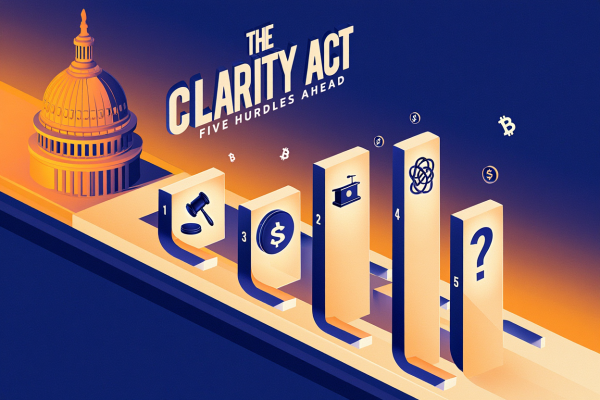
An analysis said the U.S. Congress’ cryptocurrency bill, the CLARITY Act (CLARITY), carries at least 5 additional hurdles beyond the issue of stablecoin interest.
On April 22, blockchain outlet The Block Crypto reported that investment bank TD Cowen cited vacancies in regulatory appointments, the possibility of folding prediction-market regulation into the bill, controversy over projects linked to the Trump family, pressure to strengthen anti-money laundering (AML) provisions, and the possibility of linking it to a credit card competition bill as the biggest variables in the bill’s path.
Jaret Seiberg (재럿 세이버그), a managing director at TD Cowen’s Washington Research Group, first pointed to staffing vacancies at the Commodity Futures Trading Commission (CFTC) as a problem. With the CFTC currently operating under a one-person leadership structure led by Chairman Michael Selig, it will not be easy for Congress to expand oversight authority through a crypto bill, he explained. Seiberg said he sees the issue as solvable, but additional commissioner nominations and confirmations could take months. He also said that if Congress is to try to move the bill by the end of July, before the August recess, related procedures must begin within the next 4 to 6 weeks.
Moves to include prediction-market regulation in the bill are also a burden. The issue spans not only sports betting, but also concerns about insider trading and conflicts of interest involving the family of U.S. President Donald Trump. Seiberg said Democrats could withdraw support for the bill even if only an amendment on prediction markets is introduced.
A cryptocurrency project, World Liberty Financial (WLFI), linked to the Trump family was also cited as a burden. Restrictions that prevented early investors from selling tokens until the end of Trump’s term have resurfaced recently, and that could make it harder for Democrats to support the bill, he explained.
It was also cited as a variable that could raise attention to AML and Bank Secrecy Act provisions that Iran discussed a plan to collect passage fees in cryptocurrency from ships passing through the Strait of Hormuz. Seiberg said Democrats could offer amendments in response, and even if the industry views them as a deal-killing "poison pill", the situation could become politically difficult to block.
The credit card competition bill is another variable. Seiberg said he expects Senators Dick Durbin and Roger Marshall to try to include the bill in the CLARITY Act. But he said that if it actually passes, the overall legislation could instead be derailed.
The stablecoin interest issue, long cited as a key point, remains unresolved. Senator Thom Tillis said in an interview with Politico that it is likely the Senate Banking Committee will not move to a vote on the CLARITY Act until at least before May. He also said compromise language would be made public only just ahead of committee review.
The compromise under discussion would bar platforms from paying interest on stablecoins deposited in their own services, while allowing rewards provided when used for payments. Tillis said the language could change depending on feedback.
Positions in the banking sector and the crypto industry have also not been settled. A source familiar with the issue claimed the crypto industry has negotiated in good faith for months, but banks appear closer to trying to delay or block legislation. The source said it is important to complete committee review and move the bill into the congressional process.
Some also say the delay itself does not need to be seen as a sign the bill will fail. In a separate memo, Seiberg said the latest schedule delay is not unusual and "just the way Washington works." Still, he said passage would require Trump’s direct involvement and a bipartisan compromise that can clear the Senate’s 60-vote threshold. He said it is "not an easy task, but not impossible," and did not completely rule out passage.
Outlooks differ. Seiberg last month put the odds of passage this year at about one-third, and warned that without resolving the hurdles, action could slip to 2027 and implementation of final rules could be delayed until 2029. Galaxy Digital, by contrast, put the odds of passage this year at about 50-50. It said uncertainty does not stem from a single issue, but from the many unresolved problems that must be addressed sequentially within limited time.
The discussion is difficult to explain with the stablecoin interest issue alone. It shows that crypto legislation is expanding beyond technical regulation into the realm of political and institutional coordination, as the regulatory vacuum, controversy over political conflicts of interest, and the possibility of being tied to other bills intersect at the same time.
 Yoonseo Lee
yslee@d-today.co.kr
Yoonseo Lee
yslee@d-today.co.kr